
Nigeria’s Leaders Since Independence: A Journey Through 66 Years of National Leadership
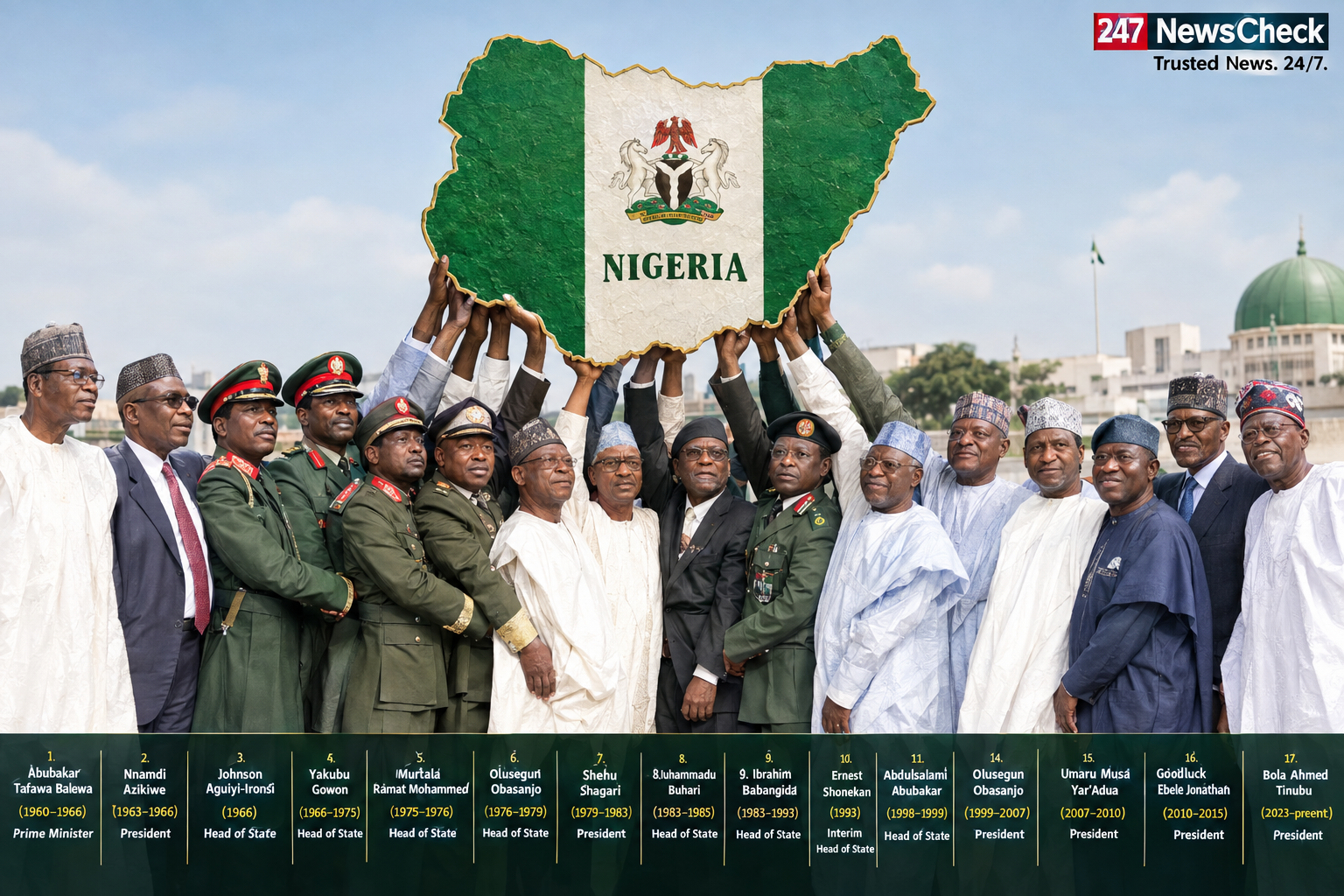
Featured image for this article.
From Abubakar Tafawa Balewa in 1960 to President Bola Ahmed Tinubu today, Nigeria’s leadership history has passed through parliamentary government, military rule, an interim government and four republics. Here is a chronological look at the leaders who have shaped the country since independence.
Nigeria became independent from British colonial rule on October 1, 1960, beginning a new chapter in the country's political history.
Since independence, Nigeria has experienced civilian governments, military rule, political transitions and the return to democratic government in 1999. The country has also moved through different constitutional arrangements, from the parliamentary system of the First Republic to presidential government under the Second Republic and the current Fourth Republic.
Over the years, a number of Nigerians have served as the country's Head of State, President or Head of Government.
As Nigeria marks another Independence Day, 247NewsCheck looks back at the leaders who have governed the country from independence in 1960 to the present day.
1. Abubakar Tafawa Balewa — Prime Minister, 1960–1966
Sir Abubakar Tafawa Balewa became Nigeria's first Prime Minister at independence on October 1, 1960.
Under the parliamentary system in place at the time, the Prime Minister was the head of government, while Nigeria's Governor-General served as head of state.
Balewa remained Prime Minister until the military coup of January 1966.
His period in office covered Nigeria's early years as an independent nation and the transition from colonial administration to self-government.
2. Nnamdi Azikiwe — Governor-General and President, 1960–1966
Dr. Nnamdi Azikiwe was Nigeria's first indigenous Governor-General after independence and became the country's first President when Nigeria became a republic on October 1, 1963.
As Governor-General, he served as the constitutional head of state while Tafawa Balewa headed the government as Prime Minister.
With the adoption of the Republican Constitution in 1963, the British monarch ceased to be Nigeria's head of state and Azikiwe became President.
He remained in office until the military coup of January 1966.
3. Johnson Thomas Umunnakwe Aguiyi-Ironsi — Head of State, 1966
Major-General Johnson Aguiyi-Ironsi became Nigeria's first military Head of State following the January 1966 coup.
His administration lasted only a few months, from January to July 1966.
Aguiyi-Ironsi was killed during the counter-coup of July 1966.
4. Yakubu Gowon — Head of State, 1966–1975
General Yakubu Gowon became Head of State in July 1966.
His nine-year period in office included the Nigerian Civil War, which lasted from 1967 to 1970.
After the war, his government pursued a programme commonly associated with reconstruction, rehabilitation and reconciliation.
Gowon was removed from office in July 1975.
5. Murtala Ramat Mohammed — Head of State, 1975–1976
General Murtala Ramat Mohammed became Head of State following the 1975 military coup.
His administration introduced a number of political and administrative changes and announced plans for Nigeria's return to civilian rule.
His time in office was cut short when he was assassinated during an attempted coup in February 1976.
6. Olusegun Obasanjo — Head of State, 1976–1979
Following the death of Murtala Mohammed, General Olusegun Obasanjo became Head of State.
Obasanjo continued the transition programme towards civilian government.
On October 1, 1979, he transferred power to an elected civilian government headed by President Shehu Shagari.
This marked the beginning of Nigeria's Second Republic.
7. Shehu Shagari — President, 1979–1983
Alhaji Shehu Shagari became Nigeria's first executive President under the 1979 Constitution.
The Second Republic replaced the parliamentary system with a presidential system of government.
Shagari's administration ended when the military took power in December 1983.
8. Muhammadu Buhari — Head of State, 1983–1985
Major-General Muhammadu Buhari became Head of State following the December 1983 military coup.
His government introduced the "War Against Indiscipline", a programme aimed at promoting discipline and order in public life.
Buhari's military government was overthrown in August 1985.
9. Ibrahim Badamasi Babangida — Head of State, 1985–1993
General Ibrahim Badamasi Babangida became Head of State in August 1985.
His administration oversaw major political and economic changes, including the Structural Adjustment Programme and a prolonged transition programme towards civilian rule.
Babangida stepped aside in August 1993 and established an Interim National Government.
10. Ernest Shonekan — Head of State, 1993
Chief Ernest Shonekan headed Nigeria's Interim National Government in 1993.
His administration lasted only a few months before General Sani Abacha took power in November 1993.
Shonekan's period in office was part of one of the most politically unsettled transition periods in Nigeria's history.
11. Sani Abacha — Head of State, 1993–1998
General Sani Abacha became Head of State in November 1993.
His government remained in power until his death in June 1998.
The period was marked by political tensions and international criticism over the government's treatment of political opponents and restrictions on political activity.
12. Abdulsalami Abubakar — Head of State, 1998–1999
General Abdulsalami Abubakar became Head of State following the death of Sani Abacha in June 1998.
His administration moved quickly towards a transition to civilian democratic government.
On May 29, 1999, Abdulsalami Abubakar handed power to an elected civilian government headed by Olusegun Obasanjo.
That transition marked the beginning of Nigeria's Fourth Republic.
13. Olusegun Obasanjo — President, 1999–2007
Olusegun Obasanjo returned to national leadership in 1999, this time as an elected civilian President.
His election marked the beginning of the Fourth Republic, Nigeria's current democratic era.
Obasanjo served two four-year terms and left office in 2007.
His second appearance in Nigeria's leadership history makes him one of the country's leaders who served under both military and civilian government.
14. Umaru Musa Yar'Adua — President, 2007–2010
Umaru Musa Yar'Adua became President in May 2007.
His administration introduced the Seven-Point Agenda and continued efforts to address development, infrastructure and security challenges.
Yar'Adua died in office in May 2010.
15. Goodluck Ebele Jonathan — President, 2010–2015
Goodluck Ebele Jonathan became Acting President following Yar'Adua's illness and subsequently became President after Yar'Adua's death.
Jonathan completed the remainder of Yar'Adua's term and was elected President in 2011.
His administration oversaw the 2015 general election, after which he transferred power to Muhammadu Buhari.
The peaceful transfer of power between the two major political parties became a significant event in Nigeria's Fourth Republic.
16. Muhammadu Buhari — President, 2015–2023
Muhammadu Buhari returned to national leadership in 2015, this time as an elected civilian President.
His administration focused on issues including security, anti-corruption efforts, infrastructure and economic reforms.
Buhari served two terms and handed over to Bola Ahmed Tinubu on May 29, 2023.
His return to power means Buhari appears twice in Nigeria's leadership timeline: first as military Head of State from 1983 to 1985 and later as elected President from 2015 to 2023.
17. Bola Ahmed Tinubu — President, 2023–Present
Bola Ahmed Tinubu became President of Nigeria on May 29, 2023, succeeding Muhammadu Buhari.
His administration inherited a number of major economic and security challenges and introduced significant economic reforms, including the removal of the petrol subsidy and changes to the foreign-exchange system.
As of October 1, 2026, Tinubu remains Nigeria's President. The Nigerian government's official portal identifies him as the current President of the Federal Republic of Nigeria.
From Independence to the Fourth Republic
Nigeria's leadership history since independence has not followed a single political system.
The country began independence under a parliamentary system in which Tafawa Balewa served as Prime Minister and Nnamdi Azikiwe served as the constitutional head of state. Nigeria became a republic in 1963, with Azikiwe as its first President.
The First Republic ended with the military coup of January 1966. Nigeria subsequently experienced a long period of military rule, interrupted by the civilian government of the Second Republic between 1979 and 1983.
Following another period of military government, democratic rule returned in 1999 with the beginning of the Fourth Republic.
Since then, Nigeria has remained under civilian democratic government, with four presidents serving before the current administration of President Bola Ahmed Tinubu.
Why Nigeria's Leadership History Matters
Understanding the people who have led Nigeria since independence provides important context for understanding the country's political development.
The leadership timeline reflects changes in Nigeria's constitutional system, military interventions, democratic transitions and the country's continuing effort to build stable democratic institutions.
It also shows that Nigeria's history cannot be understood simply by listing its presidents. Some leaders served as military Heads of State, while others served as elected presidents. In the country's first years of independence, the Prime Minister and head of state were separate offices.
For younger Nigerians, the timeline provides a way to understand how the country moved from independence in 1960, through the First and Second Republics, military rule and political transitions, to the Fourth Republic that began in 1999.
A Nation, Many Eras
From Tafawa Balewa's government at independence to the present administration of Bola Ahmed Tinubu, Nigeria's leadership history spans more than six decades.
The country has experienced major political changes during that period, but the central idea of Nigeria as one sovereign nation has remained.
As Nigerians reflect on the country's journey, knowing who led the nation, when they served and under what political system they governed provides an important foundation for understanding Nigeria's past and present.
NOTE:- Historical records from the National Institute for Cultural Orientation, Nigeria's Senate Committee on Constitution Review, the Federal Ministry of Information and National Orientation, and the Nigerian government's official portal.