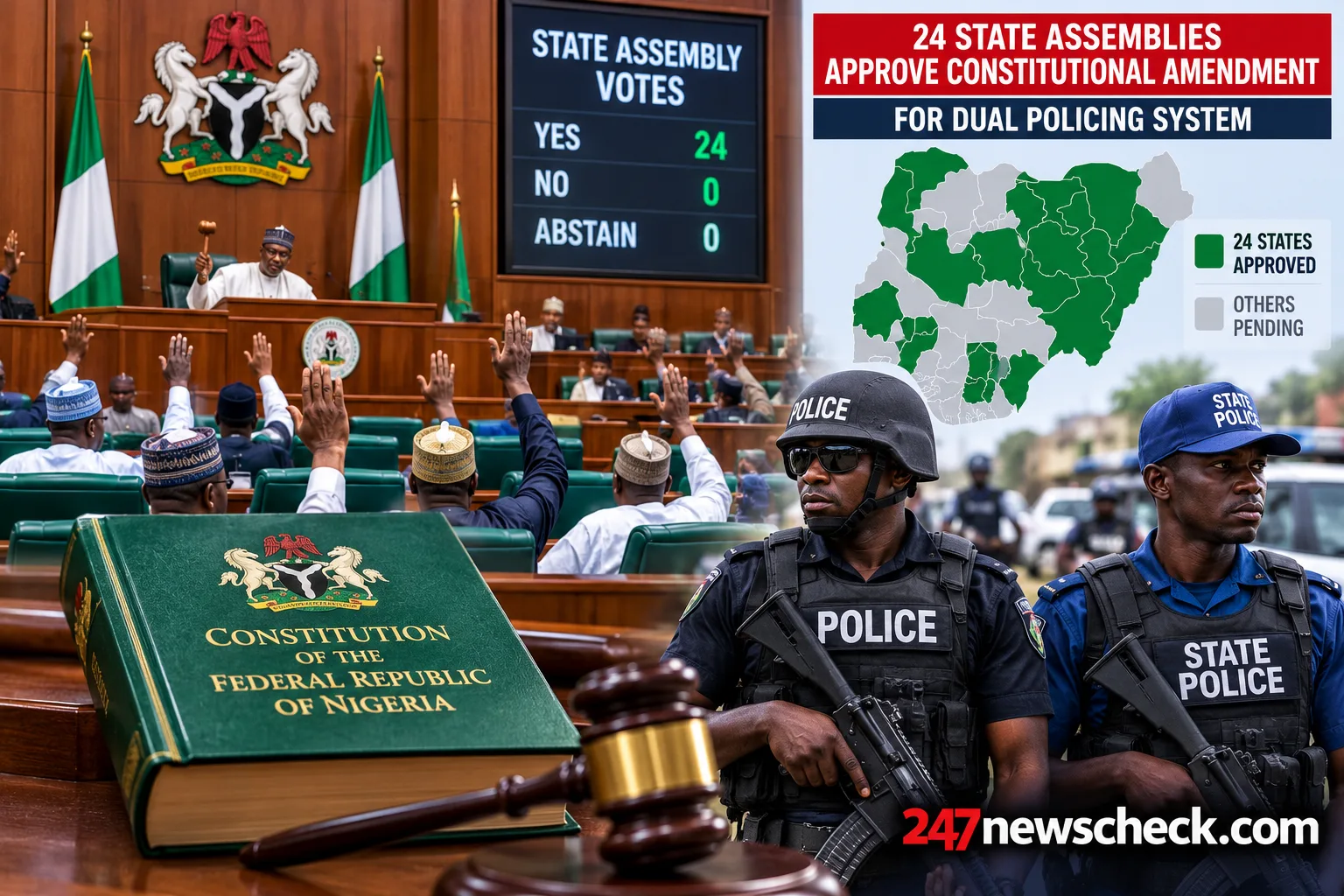
Nigeria’s plan to establish state police alongside the federal policing system has reached a significant constitutional milestone after 24 State Houses of Assembly approved the Constitution (Sixth Alteration) Bill, 2026.
The Presidential Working Group on the National Policing Bill confirmed the development in a statement issued on Friday, 23 October 2026, saying the approvals met the constitutional requirement of two-thirds of Nigeria’s 36 state legislatures.
The announcement marks an important step in efforts to decentralise policing as the country continues to confront security challenges, including kidnapping, terrorism, banditry and communal violence.
Constitutional Threshold Reached
The approval by 24 state assemblies satisfies the state-legislature threshold required under Section 9 of the 1999 Constitution, as amended, for a constitutional alteration.
The proposed amendment had previously been passed by both chambers of the National Assembly before being forwarded to state legislatures for consideration.
Femi Gbajabiamila, Chief of Staff to President Bola Tinubu and chairman of the Presidential Working Group on the National Policing Bill, welcomed the development and commended the state assemblies for supporting the proposed reform.
According to the working group, the amendment can now be returned to the National Assembly for transmission to the President for assent in line with the constitutional procedure.
The approval is a significant legislative achievement, but it should not be confused with the immediate commencement of state police operations. The remaining formal steps and the legal framework needed to implement the system must still be completed.
How the Proposed Dual Policing System Would Work
The proposed arrangement would establish a Federal Police Service alongside State Police Services, creating a framework under which state governments could operate their own police institutions within the limits set by the Constitution and relevant legislation.
Supporters of decentralised policing argue that state-level services could improve local intelligence gathering, strengthen community relations and help security personnel respond more quickly to crimes in their jurisdictions.
They also contend that policing structures closer to local communities may be better positioned to understand specific security threats and coordinate responses with residents and other relevant institutions.
However, the effectiveness of such a system would depend on clearly defined responsibilities, professional standards, sustainable funding and effective coordination between federal and state authorities.
National Policing Bill Under Review
The constitutional amendment forms part of a broader reform process that includes the proposed National Policing Bill, 2026.
In its 23 October statement, the Presidential Working Group disclosed that the draft bills were undergoing legislative drafting review and validation at the Federal Ministry of Justice. The documents were expected to be returned to the working group on or before 30 October 2026 for further consideration.
The proposed legislation is intended to provide the framework needed to implement the dual policing structure. Its final provisions will be important in defining institutional responsibilities, operational arrangements and accountability requirements.
The review process therefore remains a key part of the reform effort, even after the state assemblies reached the constitutional approval threshold.
Accountability and Political Independence Remain Critical
The proposed establishment of state police has generated debate about how to prevent political interference, protect human rights and ensure that law enforcement remains accountable to the public.
Critics have raised concerns about the possibility of state-level police institutions being used to intimidate political opponents or target individuals and groups. Differences in funding and administrative capacity between states could also affect the quality and consistency of policing.
Addressing these risks will require credible oversight mechanisms, transparent complaints procedures, professional training and clear safeguards against the abuse of police powers.
Funding is another major consideration. State governments would need adequate resources to recruit, train, equip and supervise personnel while maintaining other essential public services.
Effective coordination would also be necessary for investigations and security operations that cross state boundaries or involve federal agencies.
What Happens Next?
With the required 24 state approvals confirmed by the Presidential Working Group, attention is turning to the next formal stages of the constitutional amendment process and the completion of the legislation intended to support implementation.
The working group said the draft bills were undergoing review at the Federal Ministry of Justice and were expected to return by 30 October for further consideration before being presented to President Bola Tinubu.
Until the necessary formal steps are completed, the proposed dual policing system should not be described as fully operational.
For Nigerians, the ultimate test will be whether the reform improves public safety, strengthens trust in law enforcement and delivers effective policing while protecting citizens’ constitutional rights.
247NewsCheck.com will continue to monitor Nigeria’s state police reform and report verified developments on the constitutional process, the National Policing Bill and the measures proposed to ensure accountability and effective implementation.