
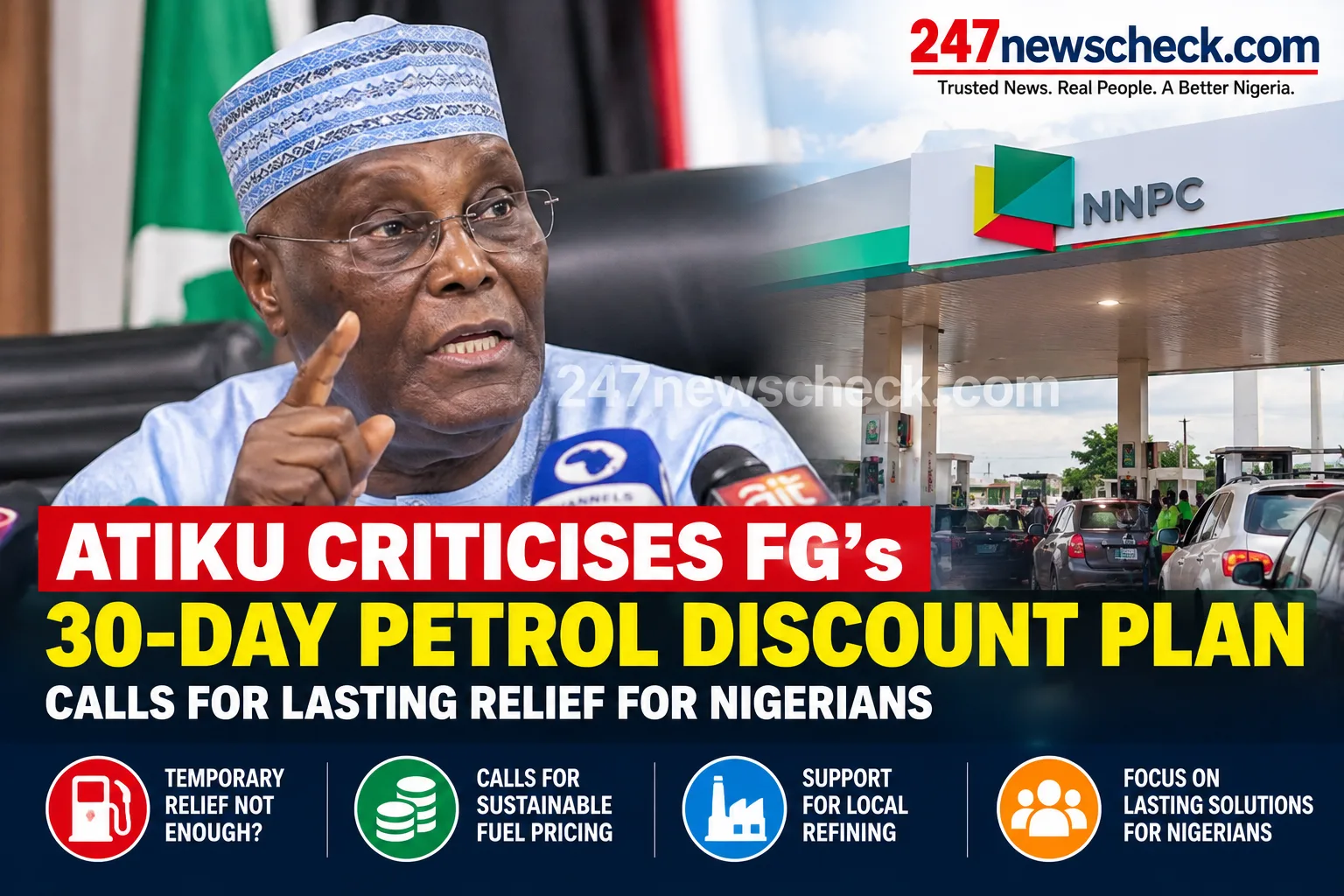
Former Vice-President Atiku Abubakar has criticised the Federal Government’s planned 30-day petrol discount at Nigerian National Petroleum Company Limited (NNPC Ltd) retail stations, arguing that the intervention may offer only temporary relief while the financial pressure on households and businesses continues.
Atiku, a presidential candidate of the African Democratic Congress (ADC), questioned the timing, coverage and long-term impact of the initiative, saying the government should focus on measures capable of reducing the cost of living beyond a short-term discount.
The criticism followed an announcement by the Federal Government that NNPC Retail would forgo its petrol retail profit margin and sell fuel at cost for a limited period to help cushion the impact of elevated fuel prices.
Atiku Questions How Long the Relief Will Last
In a statement issued on Thursday, October 8, through Phrank Shaibu, Director of Strategic Communication of the ADC Presidential Campaign Council, Atiku argued that a temporary price reduction would not resolve the wider economic challenges facing Nigerians.
He questioned what would happen after the intervention expires, particularly if petrol prices, transport fares and food costs remain high.
According to Atiku, Nigerians need a lasting solution that can reduce the pressure on household budgets rather than a measure that provides relief for only a limited period.
He also questioned whether the government’s announcement would translate into meaningful savings for ordinary motorists, commuters, traders and small-business owners.
The former vice-president’s position centers on the concern that a short-term intervention may not significantly improve living conditions unless it is accompanied by policies that address the factors driving fuel and transportation costs.
Concerns Over NNPC Stations and Transport Fares
Atiku also questioned the scope of the proposed discount, which is linked to NNPC retail outlets rather than a uniform price reduction across every filling station in the country.
He noted that the government had not clearly stated how much customers would save per litre under the arrangement.
Another concern raised by the former vice-president was whether commercial transport operators would pass any savings on to passengers.
Petrol prices affect more than private motorists. Transport operators rely on fuel to move passengers and goods, while businesses often face higher distribution costs when energy prices rise.
If a fuel discount reduces operating expenses for transporters, the practical benefit to commuters will depend partly on whether those savings translate into lower fares.
For households already managing the cost of food, rent, school expenses and transportation, the difference between a temporary announcement and a measurable reduction in daily expenses could be significant.
Atiku Renews Call for Support for Locally Refined Petrol
The ADC figure also used the debate to restate his proposal for capped and budgeted production support tied to petroleum products refined in Nigeria.
He argued that such an approach could support domestic refining while helping consumers access fuel at more affordable prices.
Atiku said any support mechanism should include safeguards to ensure that the benefits reach consumers and that public spending remains controlled and transparent.
His proposal differs from the government’s announced retail intervention. While the NNPC arrangement focuses on temporarily foregoing the company’s retail profit margin, Atiku is advocating a production-support framework linked to locally refined petroleum products.
The two approaches therefore involve different mechanisms, funding considerations and potential effects on the domestic fuel market.
Whether either approach can provide sustainable relief will depend on its implementation, costs, oversight and ability to pass benefits on to consumers.
FG Says the Measure Is Not a Return to Petrol Subsidy
The Federal Government has maintained that the NNPC intervention should not be interpreted as a restoration of the former petrol subsidy.
Finance Minister and Coordinating Minister of the Economy, Taiwo Oyedele, announced the measure as part of efforts to cushion the impact of higher global petroleum prices on Nigerians.
The Presidency said NNPC Retail had agreed to forgo its retail profit margin and sell petrol at cost during the intervention.
In a statement dated October 9, NNPC also clarified that the arrangement did not establish a uniform national pump price or change the market-based pricing framework for petroleum products.
The company said a discount introduced on October 1 to mark Nigeria’s Independence anniversary would continue until October 31 across NNPC Retail stations nationwide.
The distinction is important because the announcement does not automatically mean that every filling station will sell petrol at the same price or that the same discount will apply at every outlet. Motorists should therefore confirm the pump price displayed at individual stations before purchasing fuel.
What the Dispute Means for Nigerians
The disagreement between Atiku and the Federal Government reflects a wider debate over how Nigeria should respond to high petrol prices and the rising cost of living.
For many households, petrol prices influence commuting expenses, the cost of transporting food and other goods, and the operating costs of businesses that depend on road transport. A temporary discount could offer some assistance to customers who can access participating NNPC outlets during the intervention. However, the size of the benefit will depend on the price difference, availability and duration of the arrangement.
The broader question is whether the measure can provide meaningful relief to households beyond the period covered by the initiative.
Its impact will also depend on whether transport operators adjust fares in response to lower fuel costs and whether businesses pass any reduction in logistics expenses on to customers. These outcomes cannot be assumed in advance and will need to be assessed as the initiative progresses.
The Road Ahead for Fuel Pricing
The Federal Government’s intervention and Atiku’s proposed production-support model represent different responses to the challenge of making petrol more affordable.
The immediate priority for consumers is clarity on the discount, the participating outlets, the duration of the arrangement and the actual savings available at the pump.
For policymakers, the challenge is to balance short-term relief with measures that support reliable fuel supply, domestic refining, transparent pricing and economic stability.
Any longer-term policy will also need to consider its funding requirements, potential market effects and the mechanisms used to ensure that intended benefits reach households and businesses.
Conclusion
Atiku Abubakar has rejected the Federal Government’s 30-day petrol discount as an insufficient response to Nigeria’s continuing cost-of-living pressures and has renewed his call for support linked to locally refined petroleum products.
The Federal Government, meanwhile, maintains that the NNPC retail intervention is a temporary relief measure rather than a return to the former petrol subsidy.
For Nigerians, the key test will be whether the initiative produces visible savings at the pump and whether those savings help reduce transport and other everyday expenses.
247NewsCheck will continue to follow developments in fuel pricing and government measures affecting households, commuters and businesses across Nigeria.