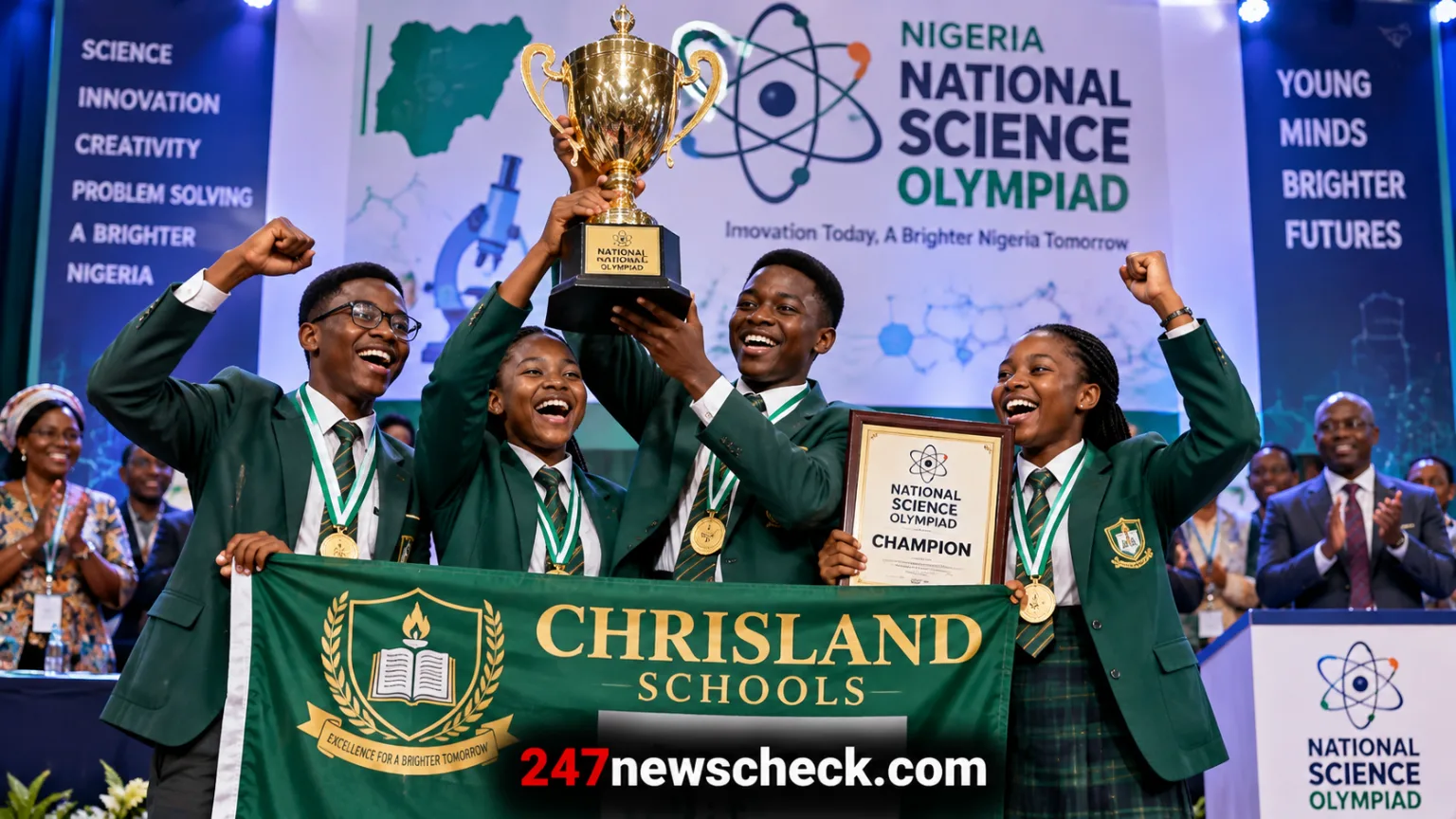
Chrisland High School, Lekki, Lagos, has emerged as the national champion in both the junior and senior secondary-school divisions of the 2026 Science Olympiad Nigeria, marking a major achievement for the school’s science education programme.
The school represented Lagos State at the national competition, securing the top position in Divisions B and C. The tournament brought together schools from different parts of Nigeria to assess students’ scientific knowledge, analytical thinking and ability to apply classroom learning to practical challenges.
The achievement places Chrisland among the schools recognised for their performance in the national science competition and highlights the role of structured science education in developing young people’s problem-solving skills.
School Claims Top Honours in Both Divisions
According to information released by Chrisland Schools, its students finished first in both the junior and senior secondary-school categories at the 2026 national championship.
The competition was held at Anchor University in Ayobo, Ipaja, Lagos State. The school subsequently celebrated the achievement at its National Championship Honours and Awards Ceremony at the Lekki campus.
The tournament featured 10 schools in each of the two divisions, providing a competitive platform for students to demonstrate their understanding of scientific concepts and their ability to work through demanding academic tasks.
Winning both categories represents a notable result for the school, particularly because the junior and senior divisions cater to students at different stages of secondary education.
Students and Coaches Recognised
The achievement involved students from both secondary-school levels, supported by teachers and coaches who helped prepare the teams for the competition.
The school acknowledged the contributions of coaches Ogunfemi Ezekiel and Luga Temege, whose preparation and guidance supported the students during their participation.
The result also reflects the contribution of school leadership and teaching staff in creating opportunities for learners to develop their interests in science beyond routine classroom instruction.
In science competitions, preparation often involves more than memorising facts. Students must interpret information, test ideas, reason through unfamiliar problems and apply scientific principles accurately under competitive conditions.
Organisers Emphasise Practical Science Education
Adewumi Odunnaike, National Director of Science Olympiad Nigeria and a United Kingdom STEM ambassador, described the achievement as the product of preparation, persistence and a commitment to learning.
He encouraged participants to remain curious, approach scientific challenges honestly and use their knowledge to address practical problems affecting society.
Examples include improving access to electricity and clean water, reducing waste and developing solutions that can support communities and economic development.
The organisers also highlighted the importance of partnerships with professional associations, engineering practitioners, businesses, foundations and alumni groups to expand students’ access to science education.
Such support can help provide learning materials, laboratory access, practical workshops, specialist coaching and mentoring opportunities for young people interested in science, technology, engineering and mathematics.
Why the Achievement Matters for Science Education
Nigeria’s long-term scientific and technological development depends partly on the quality of education and the opportunities available to students who demonstrate an aptitude for scientific inquiry.
Competitions such as Science Olympiad Nigeria can complement conventional teaching by encouraging learners to apply concepts, collaborate with peers and develop confidence in tackling unfamiliar problems.
They can also help teachers identify students who may benefit from further academic enrichment, specialist mentoring and advanced STEM programmes.
However, sustaining that progress requires more than success at a single competition. Schools need access to well-equipped laboratories, qualified teachers, relevant learning resources and opportunities for students to continue developing their skills after the awards have been presented.
Chrisland’s double victory therefore offers an opportunity to build on the students’ achievement through continued practical learning, innovation and exposure to real-world scientific challenges.
Looking Beyond the Trophy
The next challenge for the students and their school will be to sustain the momentum created by the national titles and translate the experience into further learning and innovation.
Continued engagement with scientific projects, mentoring and practical experimentation can help students develop the skills required for future studies and careers in fields such as medicine, engineering, environmental science and technology.
The achievement also provides an opportunity for parents, educators and other stakeholders to encourage young learners to see science not simply as an examination subject but as a means of understanding problems and developing solutions.
247NewsCheck.com will continue to monitor developments in science education, student competitions and STEM initiatives across Nigeria as further verified information becomes available.