
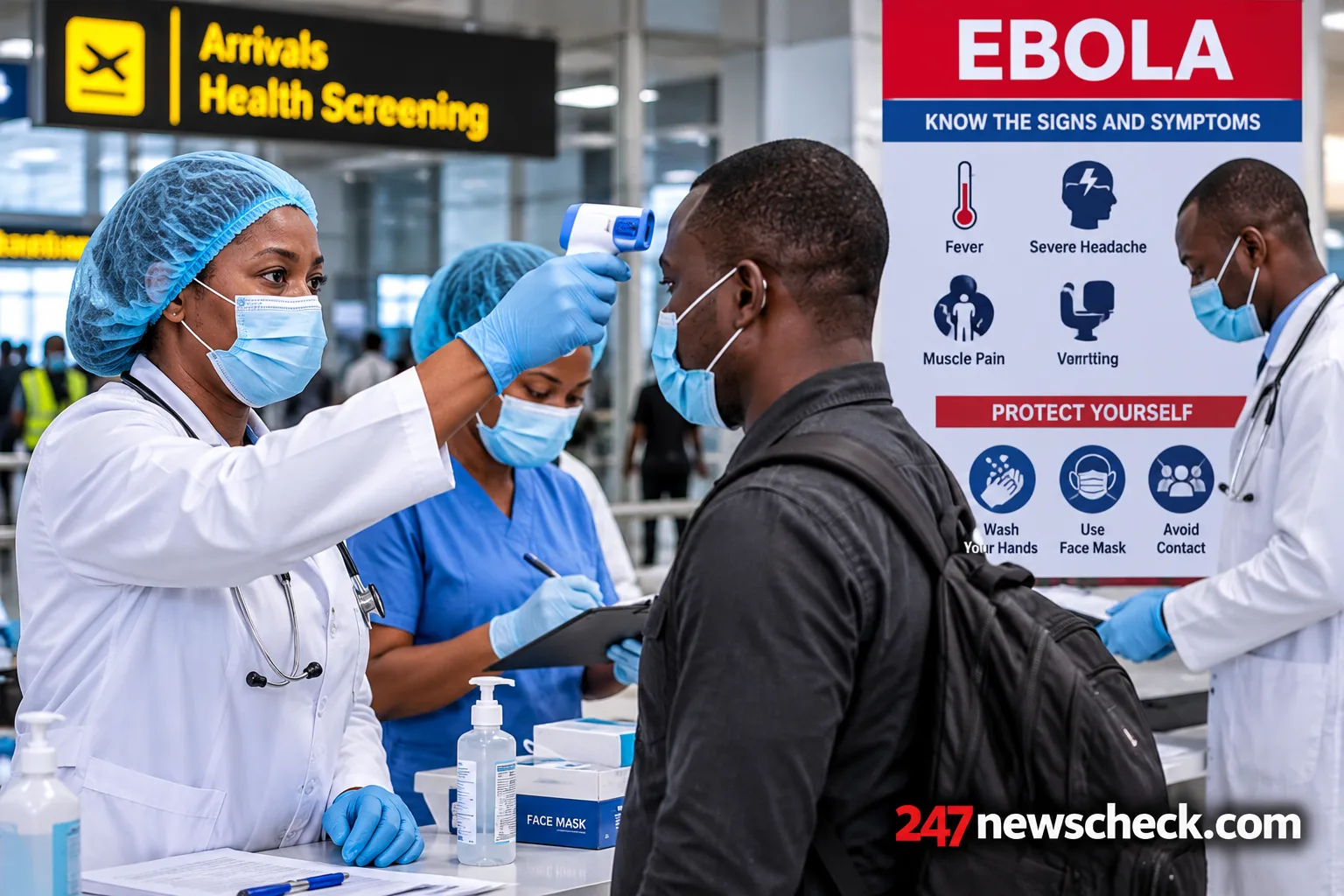
Nigeria's Federal Government has directed relevant government agencies, health institutions and other stakeholders to strengthen compliance with approved Ebola Virus Disease (EVD) screening procedures at the country's designated points of entry following concerns raised by the Office of the National Security Adviser (ONSA) over reported breaches.
The directive, issued by the Federal Ministry of Health and Social Welfare, underscores the importance of effective border health surveillance, early detection and coordinated emergency preparedness as Nigeria responds to the risk of imported Ebola infections.
In a statement released on Friday, 23 October 2026, the ministry said the action followed concerns communicated by ONSA regarding reported non-compliance with government-approved Ebola entry protocols.
The ministry subsequently instructed the relevant Ministries, Departments and Agencies (MDAs), health institutions and other stakeholders to ensure that the prescribed procedures are consistently implemented at all designated entry points.
The measures are intended to strengthen Nigeria's capacity to identify potential public health threats and limit the possibility of cross-border transmission.
Federal Government Demands Strict Compliance
The directive was contained in circular number PS/FMOH/08/VIII/48, dated 22 October 2026 and signed by the ministry's Permanent Secretary, Daju Kachollum, on behalf of the Coordinating Minister of Health and Social Welfare, Professor Muhammad Ali Pate.
The ministry emphasised that the approved measures must be enforced consistently, effectively and without discrimination.
Relevant institutions were instructed to comply with prescribed screening procedures, health declaration requirements, surveillance arrangements and other applicable entry protocols.
The circular also called for stronger coordination and information-sharing among the agencies responsible for implementing the measures.
These steps are considered important for identifying travellers who may require further assessment, ensuring that relevant information reaches the appropriate authorities and supporting a timely response when a potential health risk is identified.
The directive further requires institutions to document and report actual or attempted breaches through established channels.
However, the ministry's public announcement did not specify the number of reported breaches, identify the entry points affected or provide details of the alleged violations.
The concerns raised by ONSA therefore highlight an enforcement issue requiring investigation and corrective action, rather than establishing that every Nigerian entry point has failed to implement the required procedures.
Screening, Health Declarations and Surveillance
The ministry's instructions cover several components of border health protection, including screening, health declarations and disease surveillance.
These procedures are intended to help health officials identify travellers who may require additional assessment based on applicable public health guidance.
Effective screening also depends on trained personnel, reliable reporting systems, clear referral arrangements and the ability to escalate suspected cases to the appropriate health authorities.
Temperature checks and symptom assessments may form part of screening procedures, but screening alone cannot identify every infected person. Some infections may not be detectable during an initial assessment, making health declarations, appropriate follow-up and wider disease surveillance important parts of a comprehensive response.
For this reason, the ministry's emphasis on coordination and information-sharing is significant. Health officials, airport authorities, immigration personnel and other relevant agencies must be able to communicate effectively when a traveller requires further assessment.
The directive also calls for monitoring and accountability mechanisms to help ensure that the approved measures are sustained rather than implemented only during periods of heightened concern.
Officials Warned Against Interference With Enforcement
The Federal Ministry of Health and Social Welfare also stressed that personnel responsible for enforcing the approved protocols should be allowed to carry out their duties professionally and without undue interference.
The instruction places responsibility on the relevant institutions to support frontline officials and address obstacles that could undermine compliance.
Agencies were further directed to circulate the advisory promptly across their departments, operational units, field offices and personnel to ensure that those responsible for implementation understand their obligations.
The ministry expects the relevant institutions to treat the directive as a priority, correct identified lapses and maintain compliance with the approved measures.
Effective implementation will require clear responsibilities, adequate operational support and a reliable process for documenting and resolving reported violations.
Why the Alert Matters to Nigeria's Public Health System
The renewed focus on border screening comes amid wider concern over the risk of Ebola spreading across national boundaries.
Ebola Virus Disease is a serious infectious illness that can cause severe disease and death. Transmission can occur through direct contact with the blood or bodily fluids of an infected person who is ill or has died, or through contaminated materials.
The risk of infection is not determined simply by a traveller's nationality. Public health assessments must consider relevant travel history, possible exposure, symptoms and applicable guidance from health authorities.
This makes consistent and non-discriminatory enforcement important. Screening systems must operate according to established protocols rather than assumptions about a person's origin or appearance.
Nigeria's experience with Ebola in 2014 demonstrated the importance of rapid identification, contact tracing, infection prevention and coordination between health agencies.
The current directive reinforces the need to maintain those capabilities and address weaknesses before they compromise the public health response.
Imported Case Places Preparedness Under Greater Scrutiny
The latest measures follow reporting of an imported Ebola case in Abuja involving a woman who had recently travelled to Nigeria. The reported case has heightened attention on the country's ability to identify possible infections and respond promptly.
Reuters reported on 22 October that the patient had tested positive for the Bundibugyo species of Ebola after initially seeking medical attention for symptoms that were suspected to be malaria. The report also raised questions about the timing of diagnosis and the effectiveness of surveillance.
The details underline why screening at entry points must operate alongside clinical awareness, laboratory testing, contact tracing and infection prevention within healthcare facilities.
A traveller who does not display recognisable symptoms during an initial screening may still require assessment later if symptoms develop or relevant exposure information emerges.
Consequently, effective preparedness cannot rely exclusively on airport temperature checks. It also requires healthcare workers to recognise potential warning signs, follow appropriate infection prevention procedures and promptly report suspected cases to public health authorities.
The status of individual cases and contacts should be determined through official health updates rather than speculation.
Coordination and Accountability Will Determine Effectiveness
The success of the directive will depend on how consistently it is implemented across airports, seaports and designated land-border entry points.
Relevant institutions must ensure that screening personnel understand the approved procedures, that health declaration information is handled appropriately and that cases requiring further assessment can be referred without unnecessary delay.
Authorities must also establish clear reporting arrangements so that suspected breaches are documented, investigated and addressed.
Public communication is another important element. Travellers need access to accurate information about applicable screening requirements, while communities should receive clear guidance on recognising symptoms and seeking medical attention.
Any response must balance effective disease control with respect for travellers' rights, confidentiality and non-discriminatory treatment.
The ministry's call for accountability indicates that compliance is expected to be an ongoing institutional responsibility, rather than a temporary reaction to the latest alert.
What Nigerians Should Understand
The heightened screening measures are intended to strengthen prevention and preparedness. They should not be interpreted as evidence that Ebola is spreading unchecked throughout Nigeria.
Members of the public should rely on updates from the Nigeria Centre for Disease Control and Prevention (NCDC), the Federal Ministry of Health and Social Welfare and other authorised health agencies.
Anyone who believes they may have been exposed to Ebola should seek prompt guidance from health professionals and follow instructions from public health authorities. People should avoid direct contact with the bodily fluids of anyone suspected of having the disease and should not attempt to manage a suspected case without appropriate medical guidance.
Accurate information, early reporting and cooperation with trained health personnel remain important to reducing the risk of transmission.
Conclusion
The National Security Adviser's concerns over reported breaches of Ebola screening protocols have prompted the Federal Ministry of Health and Social Welfare to reinforce compliance requirements at Nigeria's designated entry points.
The directive places emphasis on effective screening, health declarations, surveillance, information-sharing, documentation of breaches and accountability among the institutions responsible for implementation.
Its impact will depend on whether the instructions lead to consistent enforcement, prompt correction of identified gaps and stronger coordination across the country's public health and border-management systems.
As Nigeria responds to the risk of imported Ebola infections, maintaining public confidence will require transparent communication, evidence-based action and timely updates from the relevant authorities.
247NewsCheck.com will continue to monitor developments concerning Nigeria's Ebola screening measures, including further government directives, verified public health updates and any official findings on compliance at the country's designated entry points.