
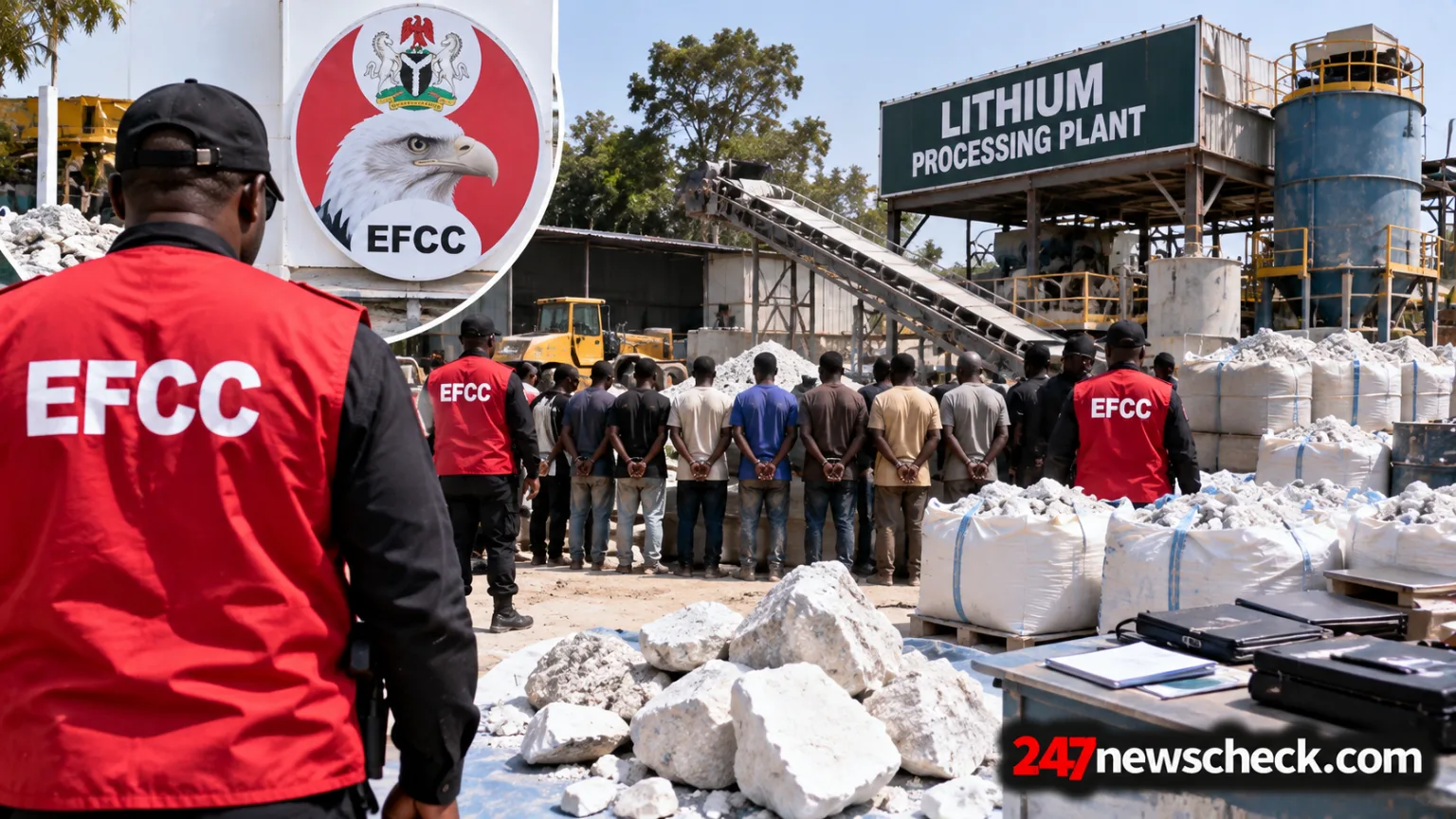
The Economic and Financial Crimes Commission (EFCC) has arrested 15 people, including 14 Chinese nationals and one Nigerian, during an operation targeting four alleged illegal lithium-processing plants in Ogere, Ogun State.
The arrests were carried out on Friday, October 23, 2026, by operatives of the commission’s Lagos Zonal Directorate 2 following intelligence gathering and surveillance, according to information released by the anti-graft agency on Monday.
The operation focused on four facilities suspected of engaging in unauthorised lithium-processing activities. The EFCC has not publicly identified the suspects or provided details about the ownership of the facilities.
Items recovered during the operation
The commission said its operatives recovered bags of lithium rocks, 18 mobile devices, four laptop computers, two decoders, a television remote control and a trailer truck.
The EFCC has not disclosed the quantity or estimated value of the lithium recovered. It has also not provided a detailed explanation of the alleged regulatory breaches or specified the individual roles of the people arrested.
According to the commission, the suspects will be charged in court after investigations have been concluded.
The announcement does not mean the suspects have been convicted of an offence. Their alleged involvement in unlawful activity remains subject to investigation and any subsequent court proceedings.
Why lithium processing is attracting attention
Lithium is an important mineral used in rechargeable batteries for mobile phones, laptops, electric vehicles and energy-storage systems. Growing demand for battery-powered technologies has increased interest in lithium resources and processing facilities across several countries, including Nigeria.
Nigeria has been seeking to develop its solid minerals industry as part of broader efforts to diversify the economy beyond crude oil. Mineral exploration, processing and value addition can create employment and contribute to industrial development when conducted in accordance with applicable laws and environmental standards.
However, suspected unauthorised operations raise questions about regulatory compliance, mineral sourcing, licensing, environmental safeguards and the collection of government revenue.
The EFCC has not yet detailed which specific legal requirements the four facilities allegedly breached. Those questions will need to be addressed through the ongoing investigation and any evidence presented in court.
Questions remain about the four facilities
Several details remain unclear following the arrests, including the identities of the suspects, the ownership of the processing plants, the source of the lithium rocks and whether the facilities held any relevant permits or approvals.
The commission has also not announced a court date or identified the charges that may eventually be filed. These details may emerge as the investigation progresses.
Establishing the facts will be important in determining the extent of any alleged wrongdoing and whether other individuals or businesses were involved.
The case also highlights the importance of effective oversight as Nigeria seeks to attract investment into its mineral resources sector. Enforcement must be accompanied by clear regulatory requirements, transparent licensing processes and safeguards against unlawful exploitation.
Implications for Nigeria’s solid minerals sector
The arrests come as Nigeria seeks to increase the contribution of solid minerals to economic growth and reduce dependence on crude oil revenues. Lithium and other minerals used in modern manufacturing have attracted growing commercial interest because of their roles in batteries, electronics and energy storage.
For the sector to deliver lasting benefits, processing operations must comply with applicable laws and regulatory requirements. Authorities must also ensure that legitimate operators can understand and meet those requirements while suspected violations are investigated fairly.
The outcome of the Ogun case could provide further information about enforcement against alleged unauthorised mineral-processing operations. Until more details are released, however, it would be premature to draw conclusions about the legality of every activity at the facilities or the culpability of the people arrested.
The EFCC has said the suspects will be charged after the conclusion of investigations. Further official statements or court filings are expected to clarify the allegations and the next steps in the case.
247NewsCheck.com will continue to monitor the EFCC investigation into the alleged illegal lithium-processing plants in Ogun State and report further verified developments, including any charges filed and subsequent court proceedings.