
For many Nigerians, a vision problem can go unnoticed for months or even years. A child may struggle to read the board in class, an older person may find it increasingly difficult to see clearly, or a trader may experience blurred vision while trying to work. In some cases, people delay seeking help because specialist eye care is far away or costs more than they can afford.
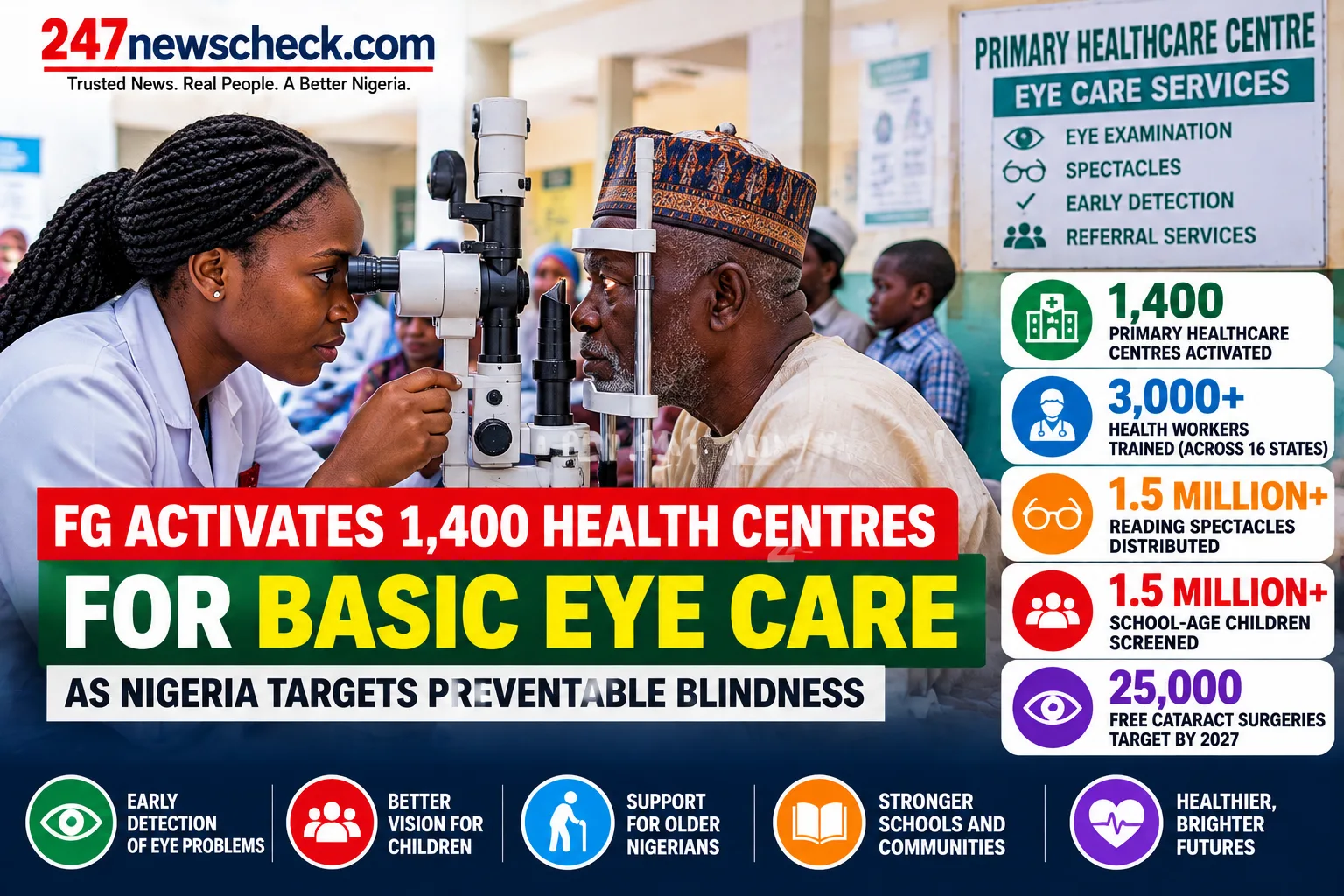
The Federal Government is taking steps to bring basic eye care closer to communities, announcing that more than 1,400 primary healthcare centers have been activated to provide primary eye care services across the country.
The Minister of State for Health and Social Welfare, Dr Iziaq Adekunle Salako, disclosed the development in Abuja on Thursday, October 8, 2026, during an event marking the 2026 World Sight Day.
The initiative is intended to strengthen the role of primary healthcare facilities in identifying common vision problems and helping patients access appropriate care. It forms part of a wider government effort to reduce avoidable blindness and make eye health services more accessible.
For Nigerians who have struggled to obtain an eye examination, the development could provide a more convenient first point of contact. However, patients should confirm which services are available at their local facility, whether appointments are required and whether any charges apply.
What the Government Has Announced
According to the Federal Ministry of Health and Social Welfare, more than 1,400 primary healthcare centers have been activated to provide basic eye care services.
The ministry also reported that more than 3,000 healthcare workers had been trained across 16 states to support the delivery of eye care at community level.
The programme is part of the government's broader approach to integrating eye health into the primary healthcare system rather than relying exclusively on specialist hospitals and occasional outreach campaigns.
Primary healthcare centers are often among the first places people visit when they need medical attention. Strengthening their ability to identify vision problems could help patients receive initial assessments closer to home and obtain referrals when more specialised treatment is necessary.
The announcement does not mean that every primary healthcare center in Nigeria now offers a full range of eye treatments. Availability may vary by location, staffing, equipment and the services established at each facility.
Patients should therefore confirm the services offered at their nearest center before making a journey.
Why Basic Eye Care Matters for Nigerian Families
Good vision affects education, employment, mobility and everyday independence. When a vision problem is not identified early, it can make ordinary activities more difficult and sometimes increase the risk of accidents.
For a schoolchild, an undetected vision problem may appear to be a learning difficulty. A pupil who cannot see classroom materials clearly may struggle to follow lessons, copy notes or complete assignments.
For adults, poor vision can affect reading, driving, operating equipment and performing work that requires accurate sight. Older people may also find daily activities more challenging when vision problems remain untreated.
Some conditions can be managed with prescription spectacles or other appropriate treatment, while others require specialist assessment. Cataracts, for example, may require surgery. Other eye conditions can cause serious damage if they are not identified and treated promptly.
This is why access to basic eye care is important. Early assessment can help identify problems, guide treatment and determine when a patient needs to see an eye specialist.
The new initiative could help reduce the distance between communities and the first stage of care, particularly for people who might otherwise postpone an examination.
What Services Might Patients Receive?
The precise services available will depend on the participating healthcare center and the training and equipment provided there. Basic primary eye care may include initial vision checks, identification of common eye problems, basic advice and referral to a suitable specialist when necessary.
Patients should ask their local facility which of these services it actually provides.
1. Initial vision checks
A basic assessment can help identify people who may have difficulty seeing clearly and need further examination. A screening result is not always a complete diagnosis, so patients with persistent symptoms may still require a more detailed assessment.
2. Identification of common eye problems
Trained healthcare workers may be able to recognise signs that suggest a patient needs further investigation. This can help people obtain appropriate care earlier, although not every eye condition can be diagnosed or treated at a primary healthcare center.
3. Guidance on spectacles
Some people need prescription spectacles to correct refractive errors. Patients should confirm whether their local facility offers vision assessment, spectacle prescriptions, spectacles themselves or only referrals.
The availability of free reading spectacles under a government programme should not be taken to mean that every type of prescription eyewear is free at every center.
4. Referral for specialist treatment
People with suspected cataracts, serious eye disease or symptoms requiring further investigation may need referral to a secondary or specialist facility.
A functioning referral pathway is important because a basic health center cannot provide every service needed to protect a person's vision.
Patients should ask where they will be referred, what the next step involves and whether they need to make an appointment.
Government Reports More Than 1.5 Million Pairs of Spectacles Distributed
The Federal Government says more than 1.5 million pairs of reading spectacles have been distributed across 16 states through the Effective Spectacle Coverage Initiative Nigeria, also known as Jajibola 2.0.
The ministry said preparations were advanced to extend the initiative to 10 additional states.
Access to appropriate spectacles can make a significant difference for people whose vision problems can be corrected with suitable lenses. It may help them read, study, work and carry out everyday tasks more comfortably.
However, reading spectacles are not suitable for every vision problem. People experiencing persistent blurred vision, eye pain, sudden changes in sight or other concerning symptoms should seek appropriate medical assessment rather than assuming that ordinary reading glasses will solve the problem.
Patients should also confirm whether spectacles are currently available at their local facility and whether they qualify under the programme.
More Than 1.5 Million School-Age Children Screened
Children's vision is another major focus of the government's eye health programme.
The Ministry of Health reported that more than 1.5 million school-age children had been screened for visual problems through the School Eye Health Programme.
Early identification is important because children may not always recognise or communicate that they cannot see clearly. Some may assume that everyone sees the same way they do, while others may simply struggle with classroom activities without understanding why.
Teachers and parents can help by paying attention to repeated complaints of blurred vision, difficulty reading the board, frequent squinting or headaches associated with visual tasks.
These signs do not automatically establish that a child has an eye disorder, but they can be reasons to arrange a proper assessment.
Screening can identify children who may need further examination. The next step is ensuring that those who require treatment or spectacles can access them.
The effectiveness of a screening programme therefore depends not only on the number of children examined but also on whether identified problems are followed up appropriately.
FG Targets 25,000 Free Cataract Surgeries by 2027
Beyond basic eye care, the Federal Government has announced a target of providing 25,000 free cataract surgeries across Nigeria by the end of 2027.
Cataracts occur when the eye's natural lens becomes cloudy, affecting vision. They are a common cause of visual impairment, particularly among older people, and surgery may be needed when the condition significantly affects daily life.
The government's target is intended to help people who need cataract treatment but may face financial or access barriers.
However, the announced national target should not be interpreted as a guarantee that every patient will receive free surgery immediately or at their nearest primary healthcare center.
Patients who suspect they have cataracts should ask a qualified health professional for an assessment and confirm whether a participating programme is available in their area, including its eligibility requirements and referral process.
Four New Vision Centers Planned in Secondary Facilities
The ministry also announced plans to establish four additional vision centers within secondary healthcare facilities in Enugu, Edo, Sokoto and Nasarawa states.
The centers are intended to strengthen the wider network of eye care services and improve referral pathways for patients who need more specialised assessment or treatment.
The arrangement reflects an important principle in healthcare delivery: community-level services are most useful when they are connected to facilities capable of providing the next level of care.
If a primary healthcare worker identifies a potentially serious condition, patients need a clear route to appropriate specialists. Without that connection, early screening may identify a problem without ensuring that the person receives the necessary treatment.
The impact of the new centers will depend on their completion, staffing, equipment and ability to receive referrals from other facilities.
What Patients Should Confirm Before Visiting a Health Centre
Although the government has announced the activation of more than 1,400 centers, patients should not assume that every service is available at every location.
Before travelling, it is useful to confirm the following:
Availability: Does the center currently provide eye care services, and on which days?
Type of assessment: Does it offer basic vision screening, a more detailed eye examination or both?
Costs: Are the consultation, tests, spectacles or medicines free, subsidised or subject to charges?
Appointments: Can patients walk in, or must they book in advance?
Referral arrangements: Where will patients be sent if they need a specialist examination or surgery?
Programme eligibility: If seeking free spectacles or cataract surgery, what conditions and documents apply?
Patients can begin by contacting their nearest primary healthcare center or the relevant state health authority. They should rely on official information rather than unverified social media claims about locations, services or free treatment.
People experiencing sudden loss of vision, severe eye pain, serious eye injuries or sudden major changes in sight should seek urgent medical attention rather than waiting for a routine screening appointment.
Why Training and Equipment Will Matter
Activating a healthcare center is an important step, but the long-term success of the programme will depend on whether facilities can deliver dependable services.
Healthcare workers need suitable training, functioning equipment, clear procedures and access to referral facilities. Equipment also requires maintenance, while staff need opportunities to update their skills.
Patients must be able to move from screening to diagnosis and treatment when necessary. A screening exercise has limited value if a person identified as needing care cannot access the next stage.
The government will also need to monitor how consistently services are provided across participating states and whether underserved communities are benefiting.
Publishing clear information about participating centers, available services and referral arrangements would help residents understand what the programme offers and how to use it.
How Better Eye Care Could Benefit the Wider Economy
Eye health is not only a medical issue. It can also affect education, productivity and household finances.
When people can see clearly and obtain appropriate treatment, they may find it easier to participate in work, education and daily activities. Children may be better placed to follow lessons, while adults may be able to carry out tasks that require good vision.
Untreated vision problems can create additional costs for families, particularly when people have to travel long distances to seek care or delay treatment until their condition becomes more difficult to manage.
Providing suitable services closer to communities could reduce some of these barriers. However, the scale of the benefit will depend on whether the centres are accessible, adequately equipped and connected to effective treatment pathways.
The government’s challenge is to turn the announced expansion into consistent services that people can use when they need them.
The Road Ahead for Eye Health in Nigeria
The activation of more than 1,400 primary healthcare centers is a significant step in the Federal Government's stated effort to expand access to basic eye care.
The training of healthcare workers, distribution of spectacles, screening of school-age children and target for cataract surgeries indicate that the programme extends beyond a single intervention.
Nevertheless, its success should ultimately be judged by the care people receive, not only by the number of facilities announced.
Nigerians will want to know whether services are available in their communities, whether treatment is affordable, whether children identified through screening receive follow-up care and whether patients needing specialist treatment can complete the referral process.
For families who have delayed eye examinations because of distance or cost, a nearby service could make seeking help easier. But clear information about eligibility, charges and available treatments will be essential.
Conclusion: Bringing Eye Care Closer to the People Who Need It
The Federal Government's eye health initiative could help more Nigerians identify vision problems earlier and access basic services closer to home.
With more than 1,400 primary healthcare centers reportedly activated, over 3,000 health workers trained across 16 states and a target of 25,000 free cataract surgeries by the end of 2027, the programme sets out an ambitious direction for improving eye health.
The next priority is to ensure that patients can access the services announced, receive appropriate assessments and reach specialist care when necessary.
For parents, students, workers and older Nigerians, the practical message is simple: do not ignore persistent vision problems, confirm the services available at your local health center and seek professional assessment when needed.
247NewsCheck will continue to follow developments in Nigeria's public health programmes, including access to eye care, patient services and the delivery of government health initiatives.