
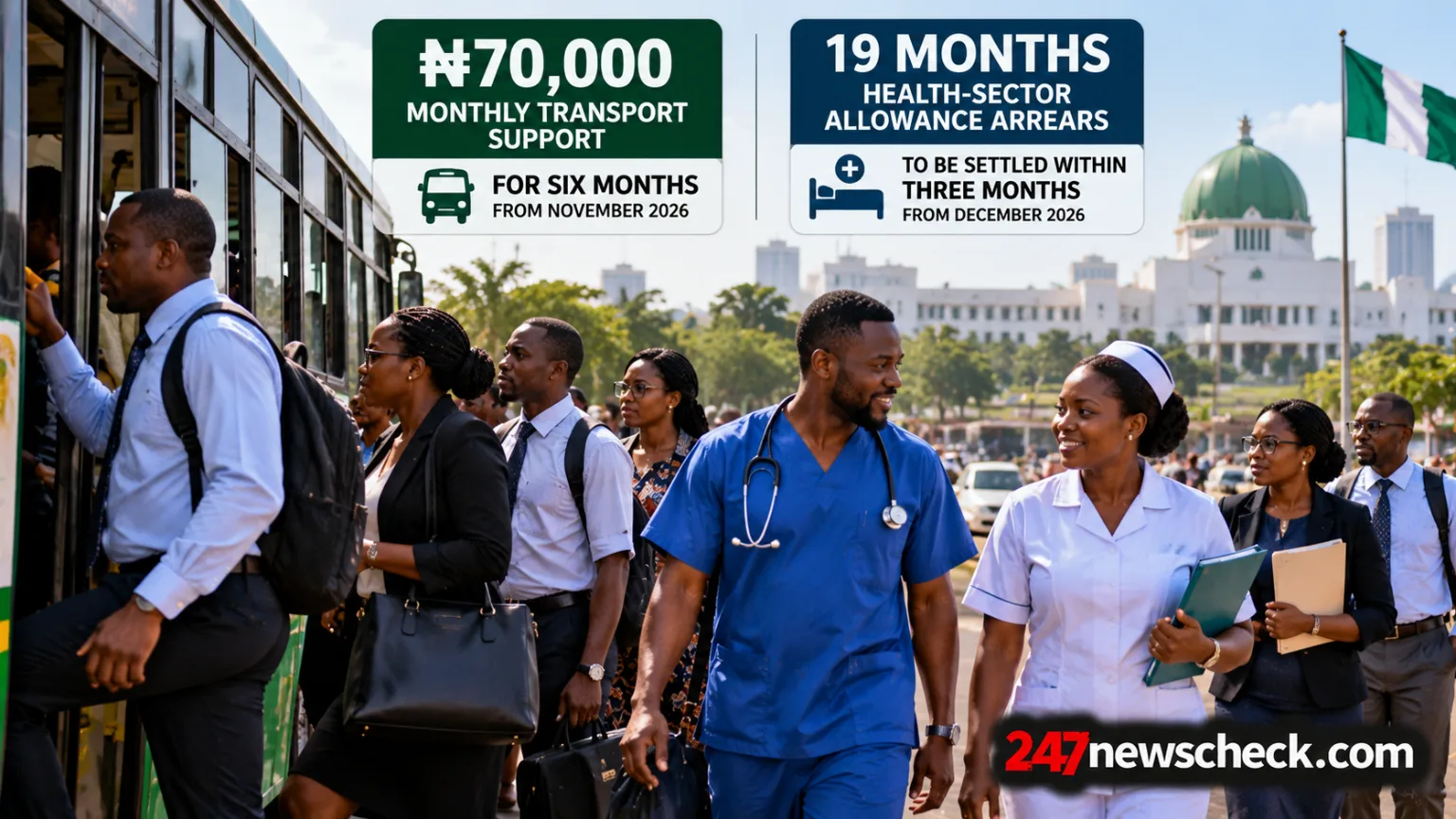
The Federal Government has agreed to introduce a six-month transport support intervention for workers and settle outstanding allowances owed to health-sector personnel, following renewed discussions with organised labour over rising living costs and workers’ welfare.
The agreements were reached at a conciliation meeting between government representatives and the Nigeria Labour Congress (NLC) in Abuja on Tuesday, October 27, 2026. The discussions addressed transport costs, outstanding allowances, minimum-wage implementation and other unresolved labour concerns.
Under the agreement, the government will provide ₦70,000 in monthly transport support for six months, beginning in November 2026. The intervention is intended to help cushion the financial pressure on workers amid persistent concerns about the cost of commuting and other essential expenses.
The agreement covers workers across the stated levels, although the published resolutions do not provide a detailed breakdown of individual beneficiaries, the payment mechanism or the precise dates on which monthly payments will be made.
Government outlines plan to clear health workers’ arrears
A major element of the agreement concerns outstanding allowances owed to health workers.
The government and organised labour agreed that 19 months of health-sector allowance arrears should be settled within three months, beginning in December 2026.
The commitment addresses a longstanding welfare concern in the health sector, where delayed payments and disputes over remuneration can add to pressure on personnel working in hospitals and other healthcare facilities.
However, the agreement does not, by itself, establish that the arrears have already been paid. The outcome will depend on implementation, including the identification of eligible workers, the processing of outstanding amounts and the release of funds within the agreed period.
The government’s delivery of this commitment will therefore be an important measure of progress in resolving the concerns raised by health-sector workers and their unions.
Other allowance payments scheduled to begin in November
The conciliation agreement also provides for the payment of outstanding peculiar allowances, effective from May 1, 2026. The accumulated arrears are scheduled to be paid in three equal monthly instalments beginning in November 2026.
The resolutions further address hazard allowances for agricultural workers. The relevant ministry has submitted beneficiary information and estimated costs to the National Salaries, Incomes and Wages Commission for verification. The process is expected to be completed within two weeks, after which an implementation template is to be issued.
The commission is also expected to update the cost assessment for a proposed adjustment to the Consolidated Health Salary Structure, known as CONHESS. That assessment is intended to support a decision by the Presidential Committee on Salaries.
These measures remain dependent on administrative processes and the implementation steps set out in the agreement.
Minimum-wage implementation date remains unresolved
Despite the progress on transport support and arrears, the government and organised labour did not reach agreement on the effective date for implementing the national minimum wage.
The parties agreed that a Minimum Wage Negotiation Committee would be constituted and begin meeting immediately. The committee is expected to provide a forum for further discussions on the outstanding disagreement.
The unresolved date means the latest agreement should not be interpreted as a final settlement of every issue relating to workers’ pay. Minimum-wage implementation, tax relief and other demands still require further consideration or decisions by the appropriate authorities.
On workers’ tax relief, the meeting agreed that the matter would be referred for further consideration through the relevant government process. The published resolutions did not announce a final tax-relief package.
Implementation will determine the impact on workers
The latest agreement offers a defined timetable for several financial interventions, but the practical effect will depend on whether the commitments are delivered as scheduled.
For workers, important questions include when the transport support will be credited, how eligible beneficiaries will be identified and whether the allowance will reach workers consistently throughout the six-month period.
For health professionals, the key test will be whether the 19 months of outstanding allowances are cleared within the agreed three-month window starting in December. Clear communication about eligibility, payment dates and progress would help workers assess the implementation of the agreement.
The government and the NLC are expected to reconvene after one month to review progress. Both sides have also called on state and local governments to participate in the intervention process and encouraged unions to pursue implementation at their respective levels.
The agreement represents progress in negotiations over workers’ welfare, but it leaves significant questions to be resolved through implementation and further talks.
247NewsCheck.com will continue to monitor the implementation of the transport-support agreement, the settlement of health workers’ allowance arrears and further developments in Nigeria’s labour negotiations as verified information becomes available.