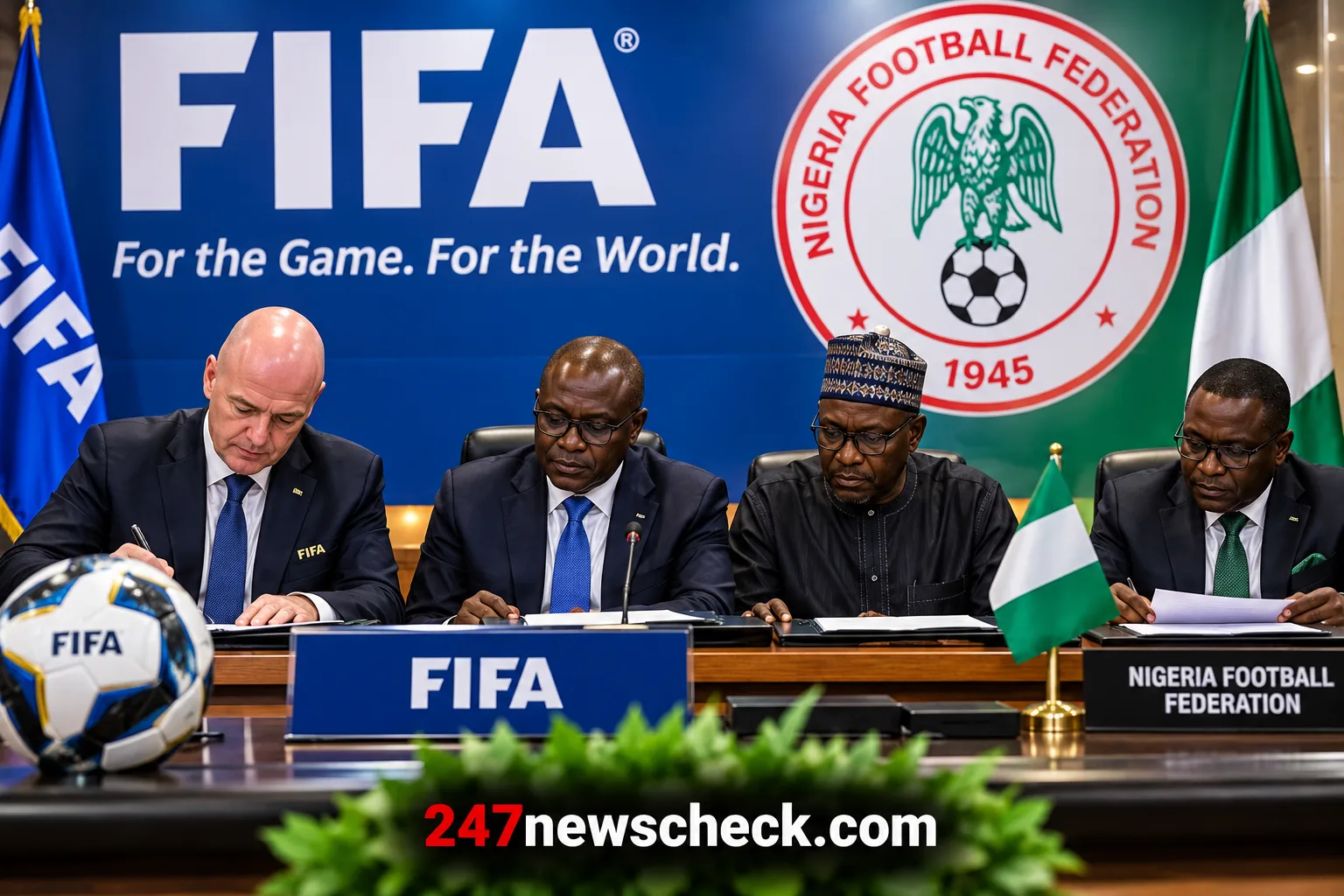
FIFA has approved the establishment of a normalisation committee to oversee the affairs of the Nigeria Football Federation (NFF), marking a significant development in efforts to restore administrative stability and prepare the federation for fresh elections.
The decision was approved by the Bureau of the FIFA Council on Thursday, 22 October 2026, following months of uncertainty surrounding the leadership of Nigerian football.
In a letter signed by FIFA Secretary General Mattias Grafström and addressed to NFF Acting General Secretary Emmanuel Ikpeme, the world football governing body confirmed that the committee’s members would be appointed jointly by FIFA and the Confederation of African Football (CAF).
The committee is expected to manage the federation’s affairs pending new elections into the NFF Executive Committee. FIFA has stipulated that its mandate must end once its assigned responsibilities have been completed and, in any event, no later than 31 May 2027.
FIFA and CAF to Select Committee Members
Under the approved arrangement, FIFA and CAF will jointly determine the composition of the normalisation committee. The identities of the members had not been announced in the NFF’s initial statement.
FIFA has also ruled that individuals appointed to the committee will not be eligible to contest any of the positions to be filled during the forthcoming NFF elections.
The restriction separates the committee’s interim administrative responsibilities from the process of selecting the federation’s next elected leadership.
Until the committee members are appointed, the NFF Secretariat will continue to handle the organisation’s daily administrative activities and the routine running of Nigerian football.
The arrangement provides for continuity in the federation’s operations while the international governing bodies complete the appointment process.
Leadership Crisis Triggered Administrative Transition
The decision follows the mass resignation of NFF President Ibrahim Musa Gusau, General Secretary Mohammed Sanusi and members of the federation’s Executive Committee on 27 August 2026.
The departures disrupted preparations for the NFF elective congress that had been scheduled for September. The electoral process was subsequently suspended as FIFA and CAF engaged Nigerian football stakeholders over the federation’s governance and the way forward.
Emmanuel Ikpeme, who previously served in the NFF administration, was left overseeing the secretariat as acting general secretary while the leadership transition continued.
The crisis unfolded amid growing dissatisfaction with the performance of Nigeria’s national teams. The Super Eagles failed to qualify for the 2026 FIFA World Cup, while the Super Falcons missed qualification for the 2027 FIFA Women’s World Cup, ending their record of appearing at every edition of the women’s tournament since it began in 1991.
These setbacks intensified calls for a review of the administration and development of football in the country.
Government Calls for Comprehensive Football Reforms
Following the NFF leadership departures, President Bola Tinubu called for comprehensive reforms of Nigerian football, including improvements in governance, administration, stakeholder representation, development pathways, domestic competitions and accountability.
The Federal Government also engaged with football stakeholders and international governing bodies as discussions continued over the appropriate framework for addressing the crisis.
However, FIFA’s approval of a normalisation committee does not, by itself, establish that the wider reform process has been completed. The committee’s composition, detailed terms of reference and implementation priorities remain important outstanding matters.
Its eventual effectiveness will depend on the scope of its mandate, the credibility of its decisions and its ability to guide the federation towards a transparent electoral process.
What the Normalisation Committee Means for Nigerian Football
Normalisation committees are interim administrative arrangements used by FIFA in certain circumstances to help member associations restore governance structures and establish conditions for new elections.
For Nigeria, the immediate task will be to oversee the federation within the mandate agreed by FIFA and CAF, maintain administrative continuity and prepare the ground for a new executive leadership.
The arrangement also presents an opportunity to address concerns about institutional accountability and the management of the domestic game. Nevertheless, a change in administrative structure alone cannot resolve the sporting and financial challenges facing Nigerian football.
Long-term progress will require effective leadership, credible competitions, sustained investment in player development and stronger structures for clubs, coaches, referees and grassroots football.
The prohibition on committee members contesting the forthcoming elections is intended to keep the interim role separate from the contest for elected office. The credibility of the transition will also depend on clear communication about the committee’s decisions and the timetable for completing its responsibilities.
May 2027 Deadline Sets a Clear Limit
FIFA has established 31 May 2027 as the latest date for the normalisation committee to complete its mandate. The committee may conclude its work earlier if all assigned tasks have been fulfilled.
The deadline gives the process a defined limit, although the precise timetable for appointing members and conducting fresh elections will become clearer as FIFA and CAF provide further details.
For Nigerian football stakeholders, attention will now turn to the composition of the committee, the priorities it adopts and the steps taken to return the NFF to elected leadership.
The decision marks a new phase in the effort to stabilise the federation. Whether it leads to lasting improvements will depend on the actions taken during the interim period and the strength of the governance arrangements that follow.
247NewsCheck.com will continue to monitor developments surrounding FIFA’s normalisation committee, the administration of Nigerian football and the timetable for fresh NFF elections as further verified information becomes available.