
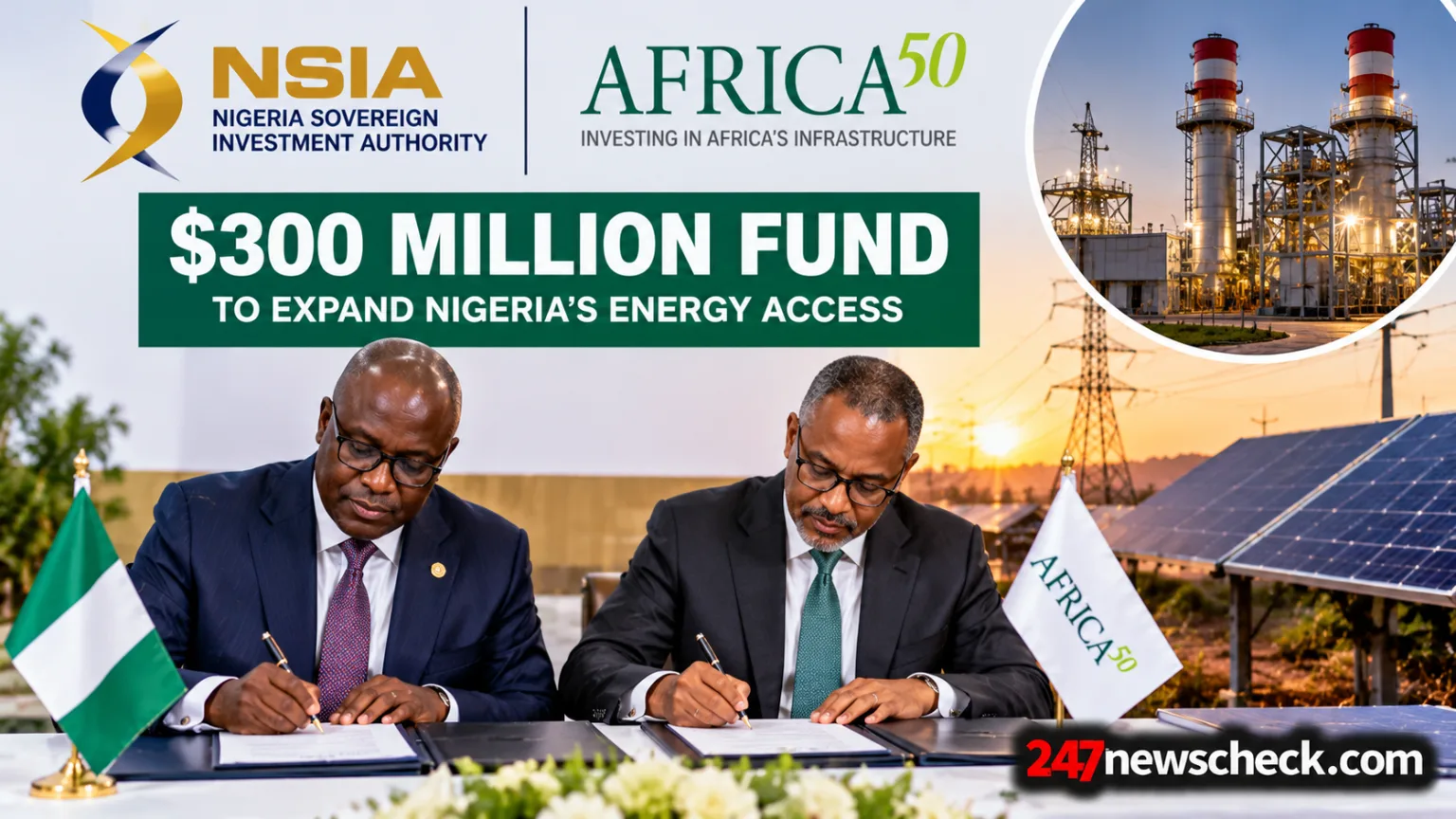
The Nigeria Sovereign Investment Authority (NSIA), Africa50 and Sustainable Energy for All (SEforALL) have launched a $300 million investment fund designed to expand access to reliable electricity in underserved communities and businesses across Nigeria.
The Nigeria Distributed Renewable Energy (DRE) Fund is intended to mobilise investment for decentralised electricity solutions, including mini-grids and standalone solar systems, as the country seeks to address persistent gaps in power supply and improve access for households, commercial enterprises and communities that remain poorly served by conventional electricity infrastructure.
The fund’s commercial launch was announced in September 2026 on the sidelines of the United Nations General Assembly in New York. The announcement marks a transition from fund structuring towards capital deployment, although the pace and scale of electricity connections will depend on project selection, financing and implementation.
According to the fund’s partners, the initiative is designed to help attract private investment into Nigeria’s distributed renewable energy sector while supporting broader national development and electricity-access objectives.
How the $300 million fund is expected to work
The fund will be co-managed by NSIA and Africa50, combining NSIA’s knowledge of the Nigerian investment environment with Africa50’s infrastructure investment and fund-management capabilities. SEforALL will contribute energy-access expertise.
The investment platform is expected to support distributed renewable energy projects that can provide electricity beyond the reach of reliable grid infrastructure or offer an alternative where conventional supply is inadequate.
Mini-grids can serve communities, clusters of businesses and public facilities through local electricity networks. Standalone solar systems can provide power to individual households, shops and other users without requiring a connection to a central grid.
Such systems can be particularly relevant to rural settlements and businesses facing unreliable electricity supply. However, their affordability and effectiveness depend on factors including installation costs, maintenance, equipment quality, financing arrangements and the ability of customers to pay for the electricity provided.
The fund’s stated objective is to help mobilise capital at a scale that can support more projects and encourage further private-sector participation in the market.
Partnership seeks to attract more investment
NSIA Managing Director and Chief Executive Officer Aminu Umar-Sadiq described the commercial launch as an important milestone for Nigeria’s distributed renewable energy market, signalling that the sector could attract investment and operate at greater scale.
Africa50 Group Chief Executive Officer Alain Ebobissé highlighted the partnership between national investment expertise, pan-African infrastructure financing and energy-access leadership. The partners have presented the fund as a financing model that could potentially be adapted for other African markets.
SEforALL, which works to advance universal access to sustainable energy, has also linked the initiative to Nigeria’s electricity-access ambitions and the wider Mission 300 programme. Mission 300 aims to connect 300 million people across Africa to electricity by 2030.
The World Bank is identified as a founding partner. Its announced initial contribution of $25 million through the International Development Association (IDA) is intended to help bridge financing sources and support the wider effort to expand electricity access.
The overall $300 million fund target should not be confused with the amount already invested in completed projects. Its impact will depend on how capital is mobilised and deployed, which projects qualify for financing and how quickly those projects deliver functioning electricity systems.
Potential implications for households and businesses
Reliable electricity is essential to economic activity. Small businesses often need power for refrigeration, lighting, communications, production equipment and digital services. Where grid supply is unreliable, enterprises may depend on petrol or diesel generators, increasing operating expenses and exposing them to fuel-price fluctuations.
Distributed renewable energy could offer some businesses and communities a more dependable alternative, particularly where solar generation and storage can be matched to local demand. Improved electricity access may also support health facilities, schools, agricultural processing and other services that depend on consistent power.
Nevertheless, the announcement alone does not establish how many Nigerian households or businesses will receive electricity through the fund, which states or communities will be prioritised, or what tariffs customers will pay. Those outcomes will depend on subsequent investment decisions and project delivery.
Transparent reporting on project locations, funding commitments, operating performance and electricity connections will therefore be important in assessing whether the fund achieves its intended development impact.
Implementation will determine the fund’s impact
Nigeria continues to face challenges in providing reliable electricity to all communities and businesses. A financing platform of this scale could help address part of the problem, but investment commitments must translate into completed infrastructure and services that consumers can afford.
The fund’s performance will depend on the quality of project preparation, the availability of additional private capital, regulatory conditions, long-term maintenance and the financial sustainability of supported energy providers.
It will also be important to measure results beyond the amount of money committed. Relevant indicators include the number of new connections, reliability of electricity supply, cost to consumers, productive uses of electricity and the durability of installed systems.
For underserved communities, the ultimate test will be whether projects improve daily life and create practical opportunities for households, public institutions and businesses.
The $300 million Nigeria DRE Fund represents a significant financing initiative for distributed renewable energy. Its contribution to national electricity access, however, will be determined by the projects it supports and the results they deliver.
247NewsCheck.com will continue to monitor the deployment of the Nigeria Distributed Renewable Energy Fund and report further verified developments on project financing, electricity connections and its impact on underserved Nigerian communities.