
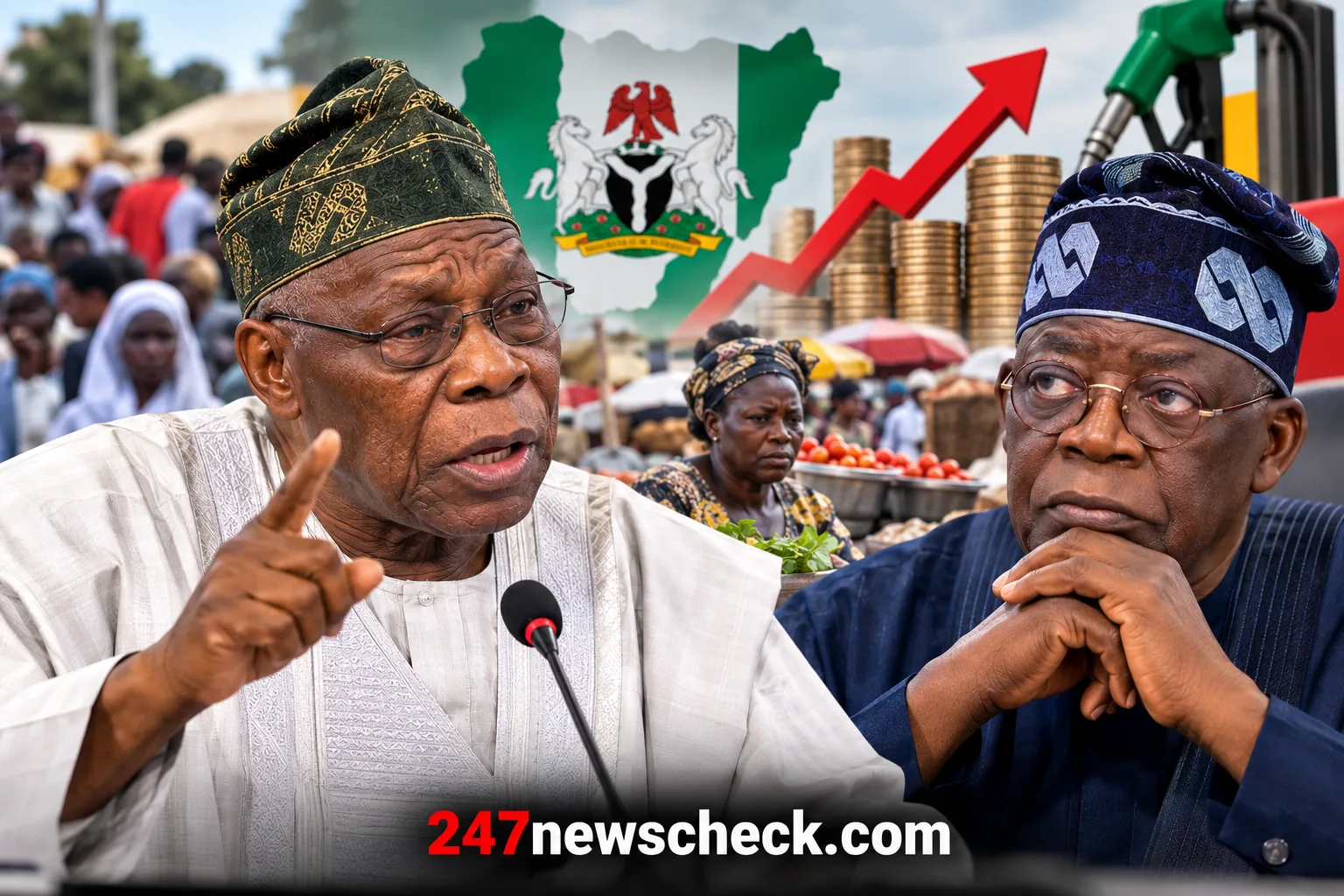
Former President Olusegun Obasanjo has criticised President Bola Tinubu’s economic policies, arguing that the sharp depreciation of the naira and the broader effects of the government’s reforms have placed a heavy burden on Nigerians.
Obasanjo made the remarks on Wednesday, October 21, 2026, during the Financial Times Africa Summit in London, where he questioned whether the economic measures introduced by the Tinubu administration had delivered sufficient benefits to justify the hardship experienced by households.
The former president focused particularly on the fall in the value of the naira following the government’s foreign exchange reforms, saying the currency’s depreciation had reduced the purchasing power of Nigerians.
He argued that the scale and speed of the decline had made it more difficult for citizens to afford goods and services, challenging the view that the reforms were producing positive outcomes for the country.
Obasanjo Questions the Impact of Naira Devaluation
During his remarks, Obasanjo said the naira’s movement from around ₦500 to the US dollar to approximately ₦1,500 to the dollar illustrated the scale of the currency’s decline.
He contended that the change had substantially weakened Nigerians’ economic position and criticised the consequences for living standards.
Obasanjo described Nigerians as having been made “poorer by 300 per cent” and argued that the outcome could not reasonably be regarded as beneficial to the country.
The percentage was part of the former president’s characterisation of the economic impact, rather than an independently established measurement of the change in every Nigerian’s wealth or income.
His criticism centres on the distinction between changes in financial and foreign exchange indicators and the actual experience of households dealing with higher prices, reduced purchasing power and pressure on disposable income.
Subsidy Removal Adds to the Economic Debate
Tinubu announced the removal of the petrol subsidy after taking office in May 2023. The decision was followed by higher petrol prices and increased transport costs, affecting the expenses of commuters, traders, manufacturers and other businesses.
In June 2023, the administration also introduced foreign exchange reforms intended to allow the naira to trade more freely and address distortions associated with the previous exchange-rate system.
The government’s stated objectives included improving the functioning of the foreign exchange market, attracting investment and addressing longstanding economic imbalances.
However, the reforms coincided with a substantial depreciation of the naira and a rise in the cost of imported goods. Higher prices for food, transport and other essential items added to the pressure on households.
These developments have fuelled an ongoing debate over whether the reforms were appropriately sequenced, whether adequate support reached vulnerable Nigerians and how quickly the anticipated benefits should become evident.
Obasanjo’s intervention adds to criticism from those who argue that economic restructuring must be assessed not only by its policy objectives but also by its effects on employment, household income and the cost of living.
Former President Sees Little Improvement in the Economy
Obasanjo also questioned whether Nigeria’s economic situation was improving sufficiently to justify calls for Tinubu to receive more time to consolidate his policies.
He said he could not see clear evidence of an improving economic outlook and challenged the argument that the president should be given another term to continue implementing the reforms.
His comments put the administration’s economic record under renewed scrutiny as political parties and public figures assess the direction of the country ahead of future electoral contests.
The former president’s position is that the policies should be judged by the results they produce for Nigerians, rather than by assurances that the benefits may emerge later.
A Dispute Over the Benefits of Reform
The disagreement reflects a wider debate about how governments should manage difficult economic adjustments.
Supporters of subsidy removal and foreign exchange reform have argued that the measures address longstanding distortions, reduce pressure on public finances and improve the conditions for a more stable economy. Critics, however, have questioned the pace of implementation and the extent to which citizens have been protected from the immediate costs.
A balanced assessment requires consideration of both the intended policy objectives and measurable outcomes, including inflation, exchange-rate stability, economic growth, employment, real wages and poverty levels.
The effect of currency depreciation also varies among households and businesses. People who depend on imported goods or have incomes that do not rise alongside prices may face greater pressure, while the consequences for exporters and other economic groups can differ.
Obasanjo’s remarks therefore highlight the importance of examining whether economic gains are reaching ordinary citizens and whether government support measures are sufficient to ease the transition.
Tinubu Administration’s Position Remains Important
The former president’s comments represent his assessment of the administration’s economic performance. A full evaluation should also consider the government’s explanation of the reforms, official economic data and any response to the specific criticisms raised in London.
No response from the Presidency to these particular remarks was confirmed in the reports reviewed for this article.
The central question is whether the reforms will translate into sustained improvements in living standards, stronger purchasing power and more reliable economic opportunities for Nigerians.
As the debate continues, the government faces pressure to demonstrate how its policies are improving conditions for households and businesses, while critics are likely to continue challenging the pace and distribution of any gains.
247NewsCheck.com will continue to follow developments concerning Nigeria’s economic reforms and report verified responses and new data as they become available.