
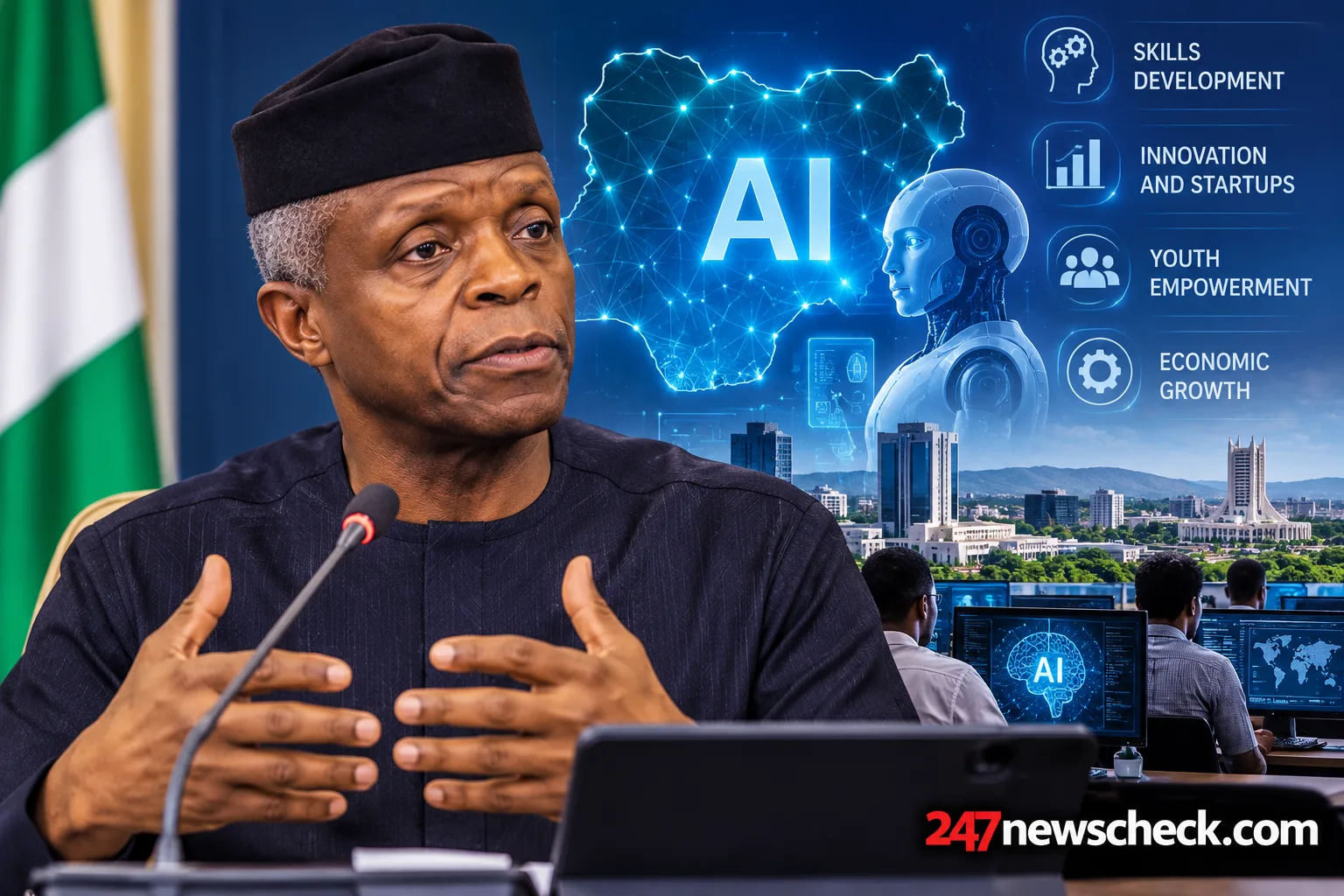
Former Vice-President Yemi Osinbajo has challenged residents and development stakeholders in Ikenne, Ogun State, to adopt a long-term development strategy that could transform the historic community into a recognised centre for artificial intelligence (AI), robotics and technological innovation in Africa.
Osinbajo presented the proposal during a lecture titled “Ikenne, a Small Town, a Great Inheritance and an Even Greater Future” at the 50th Ereke Day anniversary organised by the Ikenne Development Association on Friday, October 23, 2026.
The proposed initiative, known as the Ikenne 2036 Plan, is designed to provide a 10-year roadmap for the community's development, with technology education, innovation and human capital development at its centre.
Rather than limiting progress to physical infrastructure, the former Vice-President argued that Ikenne should invest in the knowledge, skills and institutions needed to compete in an economy increasingly influenced by artificial intelligence.
His proposal draws on the community's historical association with influential Nigerian educationists and political leaders, particularly the late Chief Obafemi Awolowo, whose educational policies helped shape the development of the former Western Region.
Why Osinbajo Is Looking to Ikenne's History
Osinbajo said the community's historical achievements should provide a foundation for its future ambitions, particularly as emerging technologies reshape education, employment and economic productivity.
He cited Awolowo's introduction of free and compulsory primary education in the former Western Region as an example of how ambitious public policy and sustained investment in people can produce lasting social change.
He also pointed to the establishment of Western Nigeria Television in 1959 as evidence that the region's leaders recognised the importance of embracing new technology at a time when such investments were still uncommon in much of the country.
According to Osinbajo, these examples demonstrate that a community's geographical size should not determine the scale of its ambitions.
He argued that Ikenne could build a new legacy by preparing young people for an economy in which artificial intelligence, robotics and advanced digital skills are expected to become increasingly important.
The former Vice-President also referenced the educational philosophy of the late Tai Solarin, who established Mayflower School in Ikenne in 1956. Solarin's emphasis on independent thinking, practical knowledge, character and the dignity of labour, Osinbajo suggested, remains relevant to the design of a modern technology-focused education system.
What the Ikenne 2036 Plan Proposes
The proposed blueprint is intended to move beyond broad declarations of ambition by establishing clear priorities, assigning responsibilities, identifying costs and setting measurable annual targets.
Osinbajo called for a structured implementation framework that would allow the community to track progress and assess whether planned investments were producing meaningful results.
A central objective is to position Ikenne as a destination for AI-enabled learning and the development of practical technological tools.
The vision would require collaboration among community leaders, educational institutions, private businesses, technology professionals, investors and public authorities.
Its success would depend not only on access to technology but also on sustained funding, effective coordination and the ability to translate educational initiatives into tangible economic opportunities.
Artificial Intelligence and Robotics in Schools
One of the major priorities outlined by Osinbajo is the integration of science, technology, engineering, arts and mathematics — commonly known as STEAM — into the educational development of the community.
He advocated introducing AI literacy at the primary-school level, alongside robotics, technology-based learning tools and adequately equipped laboratories.
The objective is to familiarise children with emerging technologies early enough to develop the knowledge and problem-solving skills required for future opportunities.
Such an approach could help pupils progress beyond being consumers of digital products towards becoming designers, developers and innovators capable of creating solutions to local problems.
However, introducing these programmes would require more than placing computers in classrooms. Schools would need reliable electricity, internet connectivity, suitable equipment, relevant learning materials and teachers who understand how to use the technology effectively.
Teacher training is therefore an essential part of the proposal.
Osinbajo called for educators to be retrained to facilitate AI-assisted learning and robotics education, rather than relying exclusively on conventional classroom methods.
If implemented effectively, the approach could strengthen digital literacy and give young people a foundation for further study and careers in technology-related fields.
Lessons from Taiwan and Other Technology Initiatives
To illustrate the potential of a focused development strategy, Osinbajo referred to Taiwan's emergence as a major player in the global semiconductor industry.
The example was intended to show that geographical size does not necessarily prevent a country or community from building specialised technological capabilities.
Taiwan's experience, however, also demonstrates the importance of sustained investment, technical education, industrial capacity, research and participation in international supply chains.
For Ikenne, the relevant lesson is not simply to replicate another economy's achievements but to identify areas in which local talent and institutions can develop competitive expertise.
Osinbajo also cited a learning centre in Maiduguri, where children affected by insurgency reportedly developed proficiency in robotics, technology and languages over several years after receiving educational support.
He used the example to illustrate how access to opportunities, structured teaching and sustained guidance can help young people overcome significant barriers.
The proposal suggests that similar investments in Ikenne could expand educational opportunities while helping the community develop a stronger base of technology skills.
Potential Applications Across Key Economic Sectors
The vision extends beyond classroom education to the development of AI tools capable of addressing practical challenges.
Osinbajo proposed establishing a campus dedicated to artificial intelligence and advanced systems, with the potential to support research, technical training and the development of solutions for sectors such as agriculture, healthcare, education and finance.
In agriculture, appropriately designed AI applications could help farmers analyse crop conditions, improve resource use and make better-informed production decisions.
In healthcare, technology could support administrative processes, assist with the analysis of information and improve access to certain services, provided that patient privacy and clinical oversight are protected.
In education, AI-enabled tools could help teachers adapt learning materials to pupils' needs, while financial applications could assist with selected tasks involving data analysis, fraud detection and service delivery.
These are potential areas of application, rather than outcomes already achieved by the proposed Ikenne plan. Turning them into working solutions would require technical expertise, suitable data, reliable infrastructure, investment and appropriate safeguards.
Osinbajo's proposal therefore places the emphasis on developing the capacity to create and adapt technology, rather than depending entirely on products developed elsewhere.
Opportunities for Young People and Local Businesses
If the proposed blueprint secures sustained support and is implemented effectively, it could create opportunities for young people to acquire technical skills, establish businesses and participate in emerging technology markets.
A stronger local technology ecosystem could also encourage partnerships between schools, startups, established companies and research institutions.
For small and medium-sized enterprises, access to digital skills and AI tools could improve productivity, support business development and open new markets.
The community's existing entrepreneurial activity could provide a foundation for such growth, although converting that potential into a sustainable innovation ecosystem would require deliberate planning and long-term investment.
The proposed plan would also need to consider access for pupils from low-income households and ensure that technology education does not become available only to those who can afford expensive equipment or private training.
Affordable access, inclusive teaching and support for underserved learners would be important measures of whether the initiative delivers broad community benefits.
The Challenges That Could Determine Success
Despite its ambitions, the Ikenne 2036 Plan would face practical challenges that must be addressed if it is to move from a proposal to a functioning development programme.
Reliable electricity, broadband connectivity, access to computing equipment and the availability of qualified instructors would be among the key requirements.
Funding would also be critical. Technology laboratories, teacher development, research facilities and specialised training programmes require continuing financial support, not just initial investment.
The community would need to identify realistic funding sources, define the responsibilities of participating institutions and establish transparent mechanisms for monitoring expenditure and performance.
Another consideration is the responsible use of artificial intelligence. As adoption expands, questions surrounding data privacy, cybersecurity, accuracy, bias and the appropriate role of human supervision will become increasingly important.
A successful strategy would need to prepare students not only to use AI tools but also to understand their limitations and apply them responsibly.
Clear targets would help determine whether the plan is delivering results. Relevant indicators could include the number of teachers trained, schools equipped, pupils reached, technology projects developed, businesses supported and graduates progressing into further education or employment.
These measures would allow residents and other stakeholders to evaluate progress against the plan's stated objectives.
What the Proposal Means for Nigeria's Technology Ambitions
The Ikenne proposal arrives at a time when artificial intelligence is becoming an increasingly important issue for African governments, businesses and educational institutions.
For Nigeria, developing domestic expertise could help expand the country's participation in the digital economy, strengthen local innovation and reduce dependence on imported technological solutions in selected areas.
The proposed community-level initiative should not be confused with a new national AI policy. It is a development vision focused on Ikenne, although its emphasis on education, skills development and practical innovation reflects broader questions facing Nigeria's technology sector.
Its significance will ultimately depend on whether the community can turn the proposal into a coordinated programme with clear priorities, adequate resources and measurable outcomes.
The plan also raises a wider question about how smaller communities can participate in technological development rather than leaving innovation exclusively to major cities and established technology centres.
If the proposal progresses beyond the planning stage, Ikenne could offer useful lessons on how local leadership, education and entrepreneurship can be brought together to support technology-led development.
Conclusion
Osinbajo's proposed Ikenne 2036 Plan presents an ambitious vision for using artificial intelligence, robotics and technology-based education to shape the future of a historic Ogun State community.
Its emphasis on early digital learning, teacher development, research and practical applications offers a potential pathway towards building local technological capacity.
Yet the difference between a compelling vision and a successful development programme will depend on implementation, funding, accountability and the ability to provide opportunities across the community.
For Ikenne, the challenge is to transform its educational and entrepreneurial heritage into a practical foundation for the next generation of innovators.
247NewsCheck.com will continue to monitor developments surrounding the proposed Ikenne 2036 Plan, including any formal adoption, funding commitments, implementation milestones and partnerships announced by the community's development stakeholders.