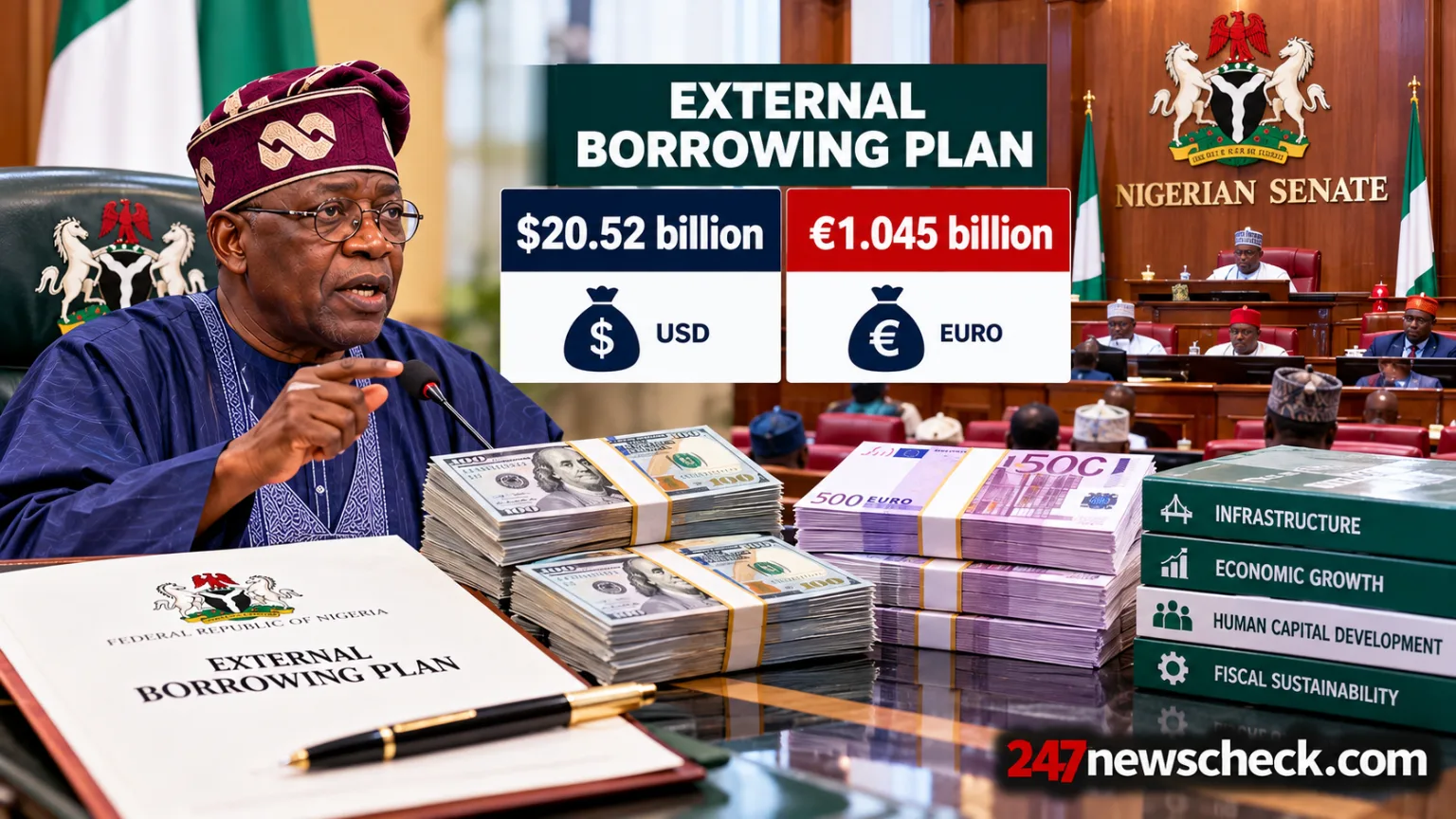
President Bola Ahmed Tinubu has asked the National Assembly to consider a supplementary external borrowing plan worth approximately $20.52 billion and €1.045 billion to finance infrastructure and development programmes across Nigeria during the 2026–2027 period.
The request was conveyed in a letter read by Senate President Godswill Akpabio during plenary on Tuesday, October 27, 2026. The proposal covers external financing facilities valued at $20,517,755,901 and €1,045,083,643.
Tinubu urged lawmakers to give the proposal early consideration, arguing that additional financing would help address funding gaps affecting major public projects and support the implementation of the government’s development priorities.
The request has not yet received final Senate approval. Following its presentation, Akpabio referred the proposal to the Senate Committee on Local and Foreign Debts for examination, with possible collaboration from the committees responsible for appropriations and finance.
Sectors targeted for investment
According to the presidential communication, the proposed borrowing plan covers a broad range of sectors, including power, transportation, agriculture, healthcare, education, water supply and security. It also identifies employment generation and public financial management reforms among the intended areas of support.
Tinubu said the projects and programmes included in the plan had undergone technical and economic assessments and were selected for their anticipated contribution to national development.
The administration argues that investment in critical infrastructure and public services is necessary to improve economic activity, strengthen essential services and address longstanding development gaps.
Power and transportation infrastructure are particularly significant to businesses because unreliable electricity and costly logistics can increase operating expenses, constrain production and discourage investment. Better healthcare, education and water infrastructure can also contribute to productivity and improved living conditions.
However, the actual benefits of the proposed financing will depend on which projects receive funding, how they are implemented and whether their outcomes can be measured against the stated objectives.
Government cites infrastructure funding gap
In his request, Tinubu maintained that the scale of Nigeria’s infrastructure needs required additional external financing to supplement available resources.
The government’s position is that borrowing can provide funds for projects that might otherwise be delayed by revenue constraints, particularly where investment is expected to support economic activity over an extended period.
The proposed plan is intended to cover projects across the federation, with the presidential communication indicating that most interventions would be implemented in the 36 states and the Federal Capital Territory.
The geographical spread could allow different parts of the country to benefit from infrastructure and development spending. Nevertheless, the distribution of projects, financing conditions and implementation schedules will be important in determining how widely those benefits are shared.
The proposal also links the planned investments to employment generation, skills acquisition, entrepreneurship development, poverty reduction and food security.
Those outcomes remain expected benefits rather than established results. They will depend on the completion of projects, the quality of public spending and the ability of funded programmes to deliver lasting improvements.
Senate to examine the proposal
After reading the presidential letter, Akpabio referred the request to the Senate Committee on Local and Foreign Debts for further legislative scrutiny.
The committee is expected to examine the proposal and may work with the Senate Committees on Appropriations and Finance. Akpabio indicated that the debt committee should report back within one week.
The Senate President also noted that elements of the borrowing plan appeared to have featured in earlier budgetary and borrowing arrangements, although he expressed uncertainty about the precise period covered by those previous approvals.
That observation makes clarification of the proposal’s scope particularly important. Lawmakers will need to establish how the latest supplementary request relates to existing authorisations and whether the amounts, projects and financing arrangements require additional approval.
The committee’s review provides an opportunity to examine the proposed borrowing before the Senate determines its next steps.
Debt sustainability and public accountability
The request comes amid continuing debate about Nigeria’s public debt, the cost of servicing existing obligations and the need to balance infrastructure investment with fiscal sustainability.
The Debt Management Office reported that Nigeria’s total public debt stood at ₦166.79 trillion as of June 30, 2026. The figure covered the obligations of the federal and state governments and the Federal Capital Territory.
While borrowing can help finance essential infrastructure, foreign-currency loans also expose public finances to exchange-rate movements and repayment obligations denominated in currencies other than the naira.
The cost of a borrowing programme cannot be assessed by its headline amount alone. Relevant details include interest rates, repayment periods, grace periods, lender conditions, disbursement schedules and the expected economic or social returns from the projects being financed.
Transparency over these terms would help lawmakers and the public evaluate whether the proposed facilities offer reasonable value and whether future repayment obligations can be managed without placing excessive pressure on public spending.
It is also important to distinguish between a request for approval and an actual drawdown of funds. The proposed amounts should not be interpreted as money already received by the government or as evidence that all listed projects have commenced.
What happens next?
The Senate committee’s examination is the next immediate step in the legislative process. Its findings should clarify the proposal’s relationship with previous borrowing approvals and provide lawmakers with a basis for further consideration.
If the plan receives the required legislative approval, the subsequent stages will include the relevant financing arrangements and implementation of the projects under the approved framework. The timing and conditions will depend on the final decisions and applicable procedures.
For Nigerians, the central issue will be whether the proposed financing translates into completed infrastructure, improved public services, more productive businesses and measurable development outcomes.
The government’s stated objectives are broad, but their success will ultimately be judged by delivery, value for money and the ability to manage the resulting debt responsibly.
247NewsCheck.com will continue to monitor the Senate’s review of the proposed external borrowing plan, including any clarifications on its scope, financing terms and intended projects, as further verified information becomes available.